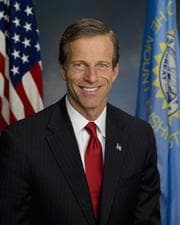

John Thune

John Thune

Republican · U.S. Senator for South Dakota

58 sponsored · 70 cosponsored

Age 65 · In office since 2005 · first in Congress 1997

Contact their office: (202) 224-2321 · 511 Dirksen Senate Office Building, Washington, DC 20510 · Official website

What they got done

Most bills never get a vote. These are the ones they wrote or backed that got somewhere.

Became law (3)

  • John Thune (R-SD)

    Their bill

    Tribal Trust Land Homeownership Act of 2025

    S. 723 Native Americans

    A Republican bill with 1 Democratic cosponsor. See the voting map.

    Became law

    The House voted 384–40 on Mar 4.

    This bill sets strict deadlines for the Bureau of Indian Affairs to review and process mortgages and related documents on Indian land.

    Yes· 2 of 13

    • Scored +7

      Would Native Americans be better off under this?

      The bill directly addresses barriers to homeownership and economic growth for Indian Tribes and their members.

    • Scored +5

      Does this make what the government does easier for the public to see?

      The bill mandates public notice of delays and annual reporting to Congress to ensure transparency.

    The opposite

    • Scored -2

      Does this give the federal government more power?

      The bill imposes new, strict administrative and reporting requirements on the Bureau of Indian Affairs.


  • Tim Scott (R-SC)

    Cosponsored

    A joint resolution disapproving the rule submitted by the Bureau of Consumer Financial Protection relating to "Overdraft Lending: Very Large Financial Institutions".

    S.J.Res. 18 Finance and Financial Sector

    A Republican resolution with 16 Republican cosponsors. See the voting map.

    Became law

    The House voted 217–211 on Apr 9.

    This is a joint resolution from the One Hundred Nineteenth Congress.

    The opposite· 2 of 5

    • Scored -5

      Would households on low incomes be better off under this?

      The removal of the overdraft rule may disproportionately affect low-income populations who rely more heavily on checking accounts.

    • Scored -5

      Does this give people more protection from unfair business practices?

      By disapproving the CFPB rule on overdraft lending, this resolution removes protections meant to regulate how large financial institutions charge for overdrafts.

    No question was scored yes.

  • Katie Britt (R-AL)

    Cosponsored

    Laken Riley Act

    S. 5 Immigration

    A Republican bill with 2 Democratic cosponsors. See the voting map.

    Became law

    The House voted 263–156 on Jan 22.

    This legislation requires the Secretary of Homeland Security to take certain inadmissible aliens into custody if they are charged with, arrested for, convicted of, or admit to committing burglary, theft, larceny, shopli…

    Yes· 2 of 5

    • Scored +3

      Does this tighten control of the border?

      The bill emphasizes the detention of aliens charged with theft, potentially contributing to increased border security efforts.

    • Scored +2

      Does this leave more decisions to the states?

      Grants State Attorneys General the power to sue the federal government, increasing state power relative to the federal government.

    The opposite· 2 of 7

    • Scored -5

      Would immigrants be better off under this?

      The bill negatively impacts immigrants facing charges, as it mandates their detention.

    • Scored -3

      Does this make it easier for immigrants already here to become citizens?

      By mandating detention for certain offenses, the bill could reduce opportunities for some immigrants to pursue a pathway to citizenship.

Passed Congress — the President's turn (3)

Both chambers passed it. The President signs it into law or vetoes it, and a veto stands unless two-thirds of each chamber vote to pass it anyway. Everything Congress has sent the President →

Passed one chamber, waiting on the other (4)

Halfway: the other chamber has to pass the same text before it can go to the President.

  • John Thune (R-SD)

    Their bill

    Accelerating Broadband Permits Act of 2026

    S. 4448 Science, Technology, Communications

    A Republican bill with 1 Democratic cosponsor.

    Passed the Senate

    With no one objecting, no names recorded

    Now: kept ready for the floor instead of being sent to a committee · Nov 20

    This bill requires the Assistant Secretary of Commerce for Communications and Information to create tools to track grant progress under the Broadband Equity, Access, and Deployment Program.

    Yes· 2 of 9

    • Scored +5

      Would people in rural areas be better off under this?

      The bill's focus on broadband deployment is critical for expanding high-speed internet access in rural areas.

    • Scored +5

      Does this get reliable internet to more people?

      The bill aims to speed up broadband deployment by improving the oversight and tracking of permit requirements and application processing times.

    No question was scored the opposite.

  • Deb Fischer (R-NE)

    Cosponsored

    North Platte Canteen Congressional Gold Medal Act

    S. 645 Armed Forces and National Security

    A Republican bill with 27 Democratic cosponsors.

    Passed the Senate

    With no one objecting, no names recorded

    Now: kept ready for the floor instead of being sent to a committee · Jun 9

    This Act authorizes the awarding of a Congressional Gold Medal to the individuals and communities who volunteered or donated to the North Platte Canteen in Nebraska during World War II.

    Yes· 2 of 4

    • Scored +5

      Would people in rural areas be better off under this?

      The bill honors a significant community-driven volunteer effort located in North Platte, Nebraska.

    • Scored +5

      Would veterans be better off under this, taking everything together?

      The bill honors the historical context of serving and supporting United States troops during World War II.

    No question was scored the opposite.

  • Amy Klobuchar (D-MN)

    Cosponsored

    Enhancing First Response Act

    S. 725 Science, Technology, Communications

    A Democratic bill with 6 Republican cosponsors.

    Passed the Senate

    With no one objecting, no names recorded

    Now: kept ready for the floor instead of being sent to a committee · Sep 11

    This bill directs the FCC to issue reports following the activation of the Disaster Information Reporting System.

    Yes· 2 of 3

    • Scored +5

      Does this make what the government does easier for the public to see?

      The bill mandates annual public hearings and the publication of reports regarding communication outages during disasters.

    • Scored +4

      Would union members be better off under this?

      The bill provides formal occupational recognition for public safety telecommunicators as a protective service occupation.

    No question was scored the opposite.

And 1 more on their Sponsored and Cosponsored pages.

Resolutions of theirs that were adopted (33)

A resolution is a chamber speaking for itself — a position, a rule or a tribute. Adopting it puts it into effect, but it is not a law.

Still waiting, of the 58 bills they wrote: 3 cleared committee and wait for a first vote, 17 are in committee. Committee is where most bills end, whoever writes them — silence there, not a vote, is the usual way a bill dies.

What their bills would do

Every bill is scored against plain yes-or-no questions. These count their bills — the ones they wrote and the ones they cosponsored — by how each question was answered: yes, or the opposite. Open one to see those bills, where each stands, and why it was scored that way. Scores are made by AI ().

Who their bills would affect

What else they would change

How they voted lately

Their latest votes that decided something, and what each measure would do.

  • U.S. Senate · Nov 20, 2026

    Bipartisan American Affordability and Jobs Act of 2026

    The vote on whether to pass the bill This is the real decision in this chamber. Passing here sends the bill to the other chamber, which must pass it too before it can go to the President.

    Their vote Yea

    This bill aims to accelerate energy projects and infrastructure development by reforming federal environmental reviews, permitting procedures, and court review rules.

    • Scored +5

      Would women be better off under this?

      By protecting settlement money from taxation, the bill provides greater financial security for women survivors of sexual violence.

  • U.S. Senate · Nov 19, 2026

    Directing the President, pursuant to section 5(c) of the War Powers Resolution, to remove United States Armed Forces from hostilities with Iran.

    The vote on whether to adopt the resolution A resolution is one chamber speaking for itself — setting its own rules, taking a position, honouring someone — and it never goes to the President. Agreeing to it is the whole decision.

    Their vote Nay

    This resolution directs the President to remove United States Armed Forces from hostilities with Iran. It uses the authority found under section 5(c) of the War Powers Resolution.

    • Scored +4

      Does this favour talking over confrontation abroad?

      Ending hostilities can pave the way for diplomatic resolutions between the US and Iran.

    • Scored -5

      Does this give the federal government more power?

      The bill limits the Executive branch's power to engage in military hostilities without Congressional approval.

  • U.S. Senate · Nov 18, 2026

    In the nature of a substitute.

    A vote on a proposed change to the bill A vote on one change, not on the bill. A bill can collect dozens of these, and losing one does not stop it.

    Their vote Yea

    This amendment amends the Internal Revenue Code of 1986 to exclude from gross income any damages, other than punitive damages, received on account of sexual acts or sexual contact.

Every vote they cast, and how often they missed one →

On the President’s nominees

The President chooses federal judges, cabinet secretaries, ambassadors and military officers, and the Senate decides whether each one gets the job. Most are confirmed by voice vote, which records no one’s position. In the 119th Congress (2025–2026) the Senate put 228 confirmations to a recorded vote, and confirmed every one.

Their votes to confirm, of 228 recorded votes

  • Yes: 228
  • No: None
  • Missed: None

Those votes covered 598 nominees, because the Senate sometimes confirms many in a single vote.

How busy they have been

How many bills they have put their name to over time — volume, not results: most bills never get a vote.

Legislative activity over time