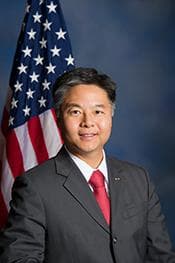


Ted Lieu

Ted Lieu

Democrat · U.S. Representative for California's 36th district

46 sponsored · 661 cosponsored

Age 57 · In office since 2015

Contact their office: (202) 225-3976 · 2454 Rayburn House Office Building, Washington, DC 20515 · Official website

What they got done

Most bills never get a vote. These are the ones they wrote or backed that got somewhere.

Became law (4)

  • Christopher Smith (R-NJ)

    Cosponsored

    United States Commission on International Religious Freedom Reauthorization Act of 2026

    H.R. 1744 International Affairs

    A Republican bill with 6 Democratic cosponsors.

    Became law

    This bill extends the operations and funding for the United States Commission on International Religious Freedom. The bill updates the timeline for annual appropriations.

    Yes

    • Scored +5

      Does this protect the freedom to practise a religion?

      The bill extends the authorization and funding for the Commission on International Religious Freedom to ensure continued oversight of religious freedom globally.

    • Scored +3

      Does this send more money or help to other countries?

      The bill reauthorizes appropriations necessary for the Commission's work on international religious freedom issues.

    No question was scored the opposite.

  • Russell Fry (R-SC)

    Cosponsored

    Trafficking Survivors Relief Act

    H.R. 4323 Crime and Law Enforcement

    A Republican bill with 8 Democratic cosponsors.

    Became law

    This bill aims to provide relief for individuals who committed crimes as a direct result of being victims of human trafficking.

    Yes· 2 of 3

    • Scored +8

      Does this shorten or soften prison sentences?

      The bill allows for vacating convictions, expunging arrests, and reducing sentences for victims of trafficking.

    • Scored +7

      Does this protect the right to fair treatment by the courts?

      The bill provides mechanisms for individuals to challenge convictions and expunge records based on trafficking victimization.

    No question was scored the opposite.

  • Pete Stauber (R-MN)

    Cosponsored

    Miracle on Ice Congressional Gold Medal Act

    H.R. 452 Sports and Recreation

    A Republican bill with 107 Democratic cosponsors.

    Became law

    This Act authorizes the award of 3 Congressional Gold Medals to the members of the 1980 U.S. Olympic Men's Ice Hockey Team. The medals recognize the team's victory over the Soviet Union during the 1980 Winter Olympics.

    Yes

    • Scored +1

      Is this likely to grow the economy?

      The sale of duplicate bronze medals provides a small influx of revenue to the United States Mint Public Enterprise Fund.

    No question was scored the opposite.

And 1 more on their Sponsored and Cosponsored pages.

Passed one chamber (20)

Halfway: the other chamber has to pass the same text before it can go to the President. 2 of these were stopped after it passed.

  • Ted Lieu (D-CA)

    Their bill

    Tyler’s Law

    H.R. 2004 Health

    A Democratic bill with 30 Republican cosponsors.

    Passed the House

    By voice vote, no names recorded

    Now: in the queue for a floor vote, with no date set · Sep 16

    This bill directs the Secretary of Health and Human Services to complete a study within one year of the bill's enactment.

    Yes· 2 of 9

    • Scored +7

      Does this do more about addiction and overdose deaths?

      Specifically targets the identification of fentanyl in overdose cases to improve patient outcomes.

    • Scored +3

      Would people in middle age be better off under this?

      Middle-aged adults suffering from overdose may receive more accurate testing and guidance.

    The opposite

    • Scored -2

      Does this protect people from being watched or searched?

      The bill identifies potential negative impacts on patient privacy and confidentiality of health information.

  • Seth Moulton (D-MA)

    Cosponsored

    Directing the President, pursuant to section 5(c) of the War Powers Resolution, to remove United States Armed Forces from hostilities with Iran.

    H.Con.Res. 93 International Affairs

    A Democratic resolution with 14 Democratic cosponsors. See the voting map.

    This resolution directs the President to remove United States Armed Forces from hostilities with Iran. It uses the authority found under section 5(c) of the War Powers Resolution.

    Yes· 2 of 7

    • Scored +4

      Does this favour talking over confrontation abroad?

      Ending hostilities can pave the way for diplomatic resolutions between the US and Iran.

    • Scored +3

      Does this reduce what is spent on the military?

      Directing the removal of forces from hostilities generally reduces the cost of military operations.

    The opposite

    • Scored -5

      Does this give the federal government more power?

      The bill limits the Executive branch's power to engage in military hostilities without Congressional approval.

  • Gus Bilirakis (R-FL)

    Cosponsored

    Major Richard Star Act

    H.R. 2102 Armed Forces and National Security

    A Republican bill with 207 Democratic cosponsors. See the voting map.

    Passed the House

    39218

    Now: handed to a committee to examine — Committee on Armed Services · Nov 12

    This bill aims to change the rules regarding how certain military retirees receive their pay. Specifically, it focuses on disability retirees who have combat-related disabilities.

    Yes· 2 of 3

    • Scored +8

      Would veterans be better off under this, taking everything together?

      This bill provides significant financial relief to veterans with combat-related disabilities by allowing them to receive both retired pay and disability compensation concurrently.

    • Scored +7

      Does this increase the pay, pensions or support veterans receive?

      The bill increases financial benefits for veterans with combat-related disabilities by allowing concurrent receipt of retired pay and disability compensation.

    No question was scored the opposite.

And 17 more on their Sponsored and Cosponsored pages.

Resolutions of theirs that were adopted (2)

A resolution is a chamber speaking for itself — a position, a rule or a tribute. Adopting it puts it into effect, but it is not a law.

Still waiting, of the 46 bills they wrote: 43 are in committee. Committee is where most bills end, whoever writes them — silence there, not a vote, is the usual way a bill dies.

What their bills would do

Every bill is scored against plain yes-or-no questions. These count their bills — the ones they wrote and the ones they cosponsored — by how each question was answered: yes, or the opposite. Open one to see those bills, where each stands, and why it was scored that way. Scores are made by AI ().

Who their bills would affect

What else they would change

How they voted lately

Their latest votes that decided something, and what each measure would do.

  • U.S. House · Nov 19, 2026

    Preventive Health Savings Act

    A fast-track vote, needing two-thirds to pass The House sets aside its normal procedure to move quickly: no amendments, little debate, and a two-thirds bar instead of a simple majority. It is used for measures expected to be uncontroversial, so a bill that fails here failed despite broad expectations that it would not.

    Their vote Yea

    This bill amends the Congressional Budget Act of 1974 regarding how preventive health savings are scored.

    • Scored +3

      Does this reduce what the federal government spends?

      By highlighting reductions in budget outlays through preventive health, the bill facilitates the identification of potential spending reductions.

  • U.S. House · Nov 18, 2026

    Earth MRI Reauthorization Act of 2026

    A fast-track vote, needing two-thirds to pass The House sets aside its normal procedure to move quickly: no amendments, little debate, and a two-thirds bar instead of a simple majority. It is used for measures expected to be uncontroversial, so a bill that fails here failed despite broad expectations that it would not.

    Their vote Yea

    This bill updates the Infrastructure Investment and Jobs Act to reauthorize the Earth Mapping Resources Initiative.

    • Scored +7

      Does this put more money into scientific research?

      Authorizes 84 million dollars to update and expand geological mapping and scientific data collection methods.

  • U.S. House · Nov 18, 2026

    Common Sense 250 Act of 2026

    A fast-track vote, needing two-thirds to pass The House sets aside its normal procedure to move quickly: no amendments, little debate, and a two-thirds bar instead of a simple majority. It is used for measures expected to be uncontroversial, so a bill that fails here failed despite broad expectations that it would not.

    Their vote Yea

    Its main purpose is to officially approve the location for a commemorative work honoring Thomas Paine. The monument is designated to be placed within a specific zone known as Area I in Washington, DC, and its environs.

Every vote they cast, and how often they missed one →

On the President’s vetoes

A vetoed bill becomes law only if two-thirds of both chambers pass it again. The President can refuse to sign a bill both chambers passed. It becomes law anyway only if two-thirds of the House and two-thirds of the Senate vote to pass it again. A vote against the veto (a Yea) was a vote to make the bill law over the President’s objection; a vote for it (a Nay) was a vote to let the veto stand.

How busy they have been

How many bills they have put their name to over time — volume, not results: most bills never get a vote.

Legislative activity over time