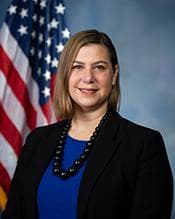

Elissa Slotkin

Elissa Slotkin

Democrat · U.S. Senator for Michigan

30 sponsored · 304 cosponsored

Age 50 · In office since 2025, in Congress since 2019

Contact their office: (202) 224-4822 · 291 Russell Senate Office Building, Washington, DC 20510 · Official website

What they got done

Most bills never get a vote. These are the ones they wrote or backed that got somewhere.

Became law (4)

  • John Cornyn (R-TX)

    Cosponsored

    Holocaust Expropriated Art Recovery Act of 2025

    S. 1884 Law

    A Republican bill with 11 Democratic cosponsors.

    Became law

    This Act seeks to clarify and improve the existing 2016 Act. It aims to ensure that claims to recover Nazi-looted art are resolved on their actual merits rather than being dismissed due to various legal technicalities.

    Yes

    • Scored +7

      Does this protect the right to fair treatment by the courts?

      The bill enhances legal recourse for victims by precluding time-based and discretionary defenses.

    No question was scored the opposite.
  • Roger Marshall (R-KS)

    Cosponsored

    Whole Milk for Healthy Kids Act of 2025

    S. 222 Agriculture and Food

    A Republican bill with 5 Democratic cosponsors.

    Became law

    This bill aims to amend the Richard B. Russell National School Lunch Act. This legislation allows schools participating in the school lunch program to offer whole milk, whether organic or non-organic.

    Yes· 2 of 6

    • Scored +5

      Would children be better off under this?

      The bill increases the variety of milk options available to students and enhances food allergy safety training for schools.

    • Scored +5

      Would students be better off under this?

      Students benefit from expanded milk choices and improved food allergy safety protocols in their schools.

    No question was scored the opposite.

  • Mike Crapo (R-ID)

    Cosponsored

    Secure Rural Schools Reauthorization Act of 2025

    S. 356 Public Lands and Natural Resources

    A Republican bill with 16 Democratic cosponsors. See the voting map.

    Became law

    The House voted 399–5 on Dec 9.

    This bill aims to extend the Secure Rural Schools and Community Self-Determination Act of 2000. It extends various deadlines and years within the original act, such as changing certain dates from 2023 to 2026.

    Yes· 2 of 7

    • Scored +5

      Would people in rural areas be better off under this?

      The bill directly extends financial payments and project authority to rural counties containing federal land.

    • Scored +5

      Does this invest in rural communities?

      The bill explicitly extends funding and authority for counties with federal lands to support their local development and special projects.

    No question was scored the opposite.

And 1 more on their Sponsored and Cosponsored pages.

Passed Congress — the President's turn (1)

Both chambers passed it. The President signs it into law or vetoes it, and a veto stands unless two-thirds of each chamber vote to pass it anyway. Everything Congress has sent the President →

  • Jerry Moran (R-KS)

    Cosponsored

    Fallen Servicemembers Religious Heritage Restoration Act

    S. 1318 Armed Forces and National Security

    A Republican bill with 11 Democratic cosponsors. See the voting map.

    Passed both chambers

    235191

    This bill consists of two main parts: the Foreign Intelligence Accountability Act and the Anti-CBDC Surveillance State Act.

    Yes· 2 of 5

    • Scored +8

      Does this protect people from being watched or searched?

      The bill strengthens protections against government surveillance and prevents the implementation of a central bank digital currency.

    • Scored +7

      Does this give people more control over their personal data?

      The bill implements stricter oversight on government access to personal data and prohibits central bank digital currency implementation.

    The opposite

    • Scored -5

      Does this give the government more power to monitor people inside the country?

      The bill acts to restrict and curb the expansion of domestic surveillance capabilities of the Federal Reserve and FBI.

    • Scored -3

      Does this give the federal government more power?

      The bill limits the expansion of federal authority regarding digital currency and surveillance.

Passed one chamber, waiting on the other (7)

Halfway: the other chamber has to pass the same text before it can go to the President.

  • Gary Peters (D-MI)

    Cosponsored

    GLRI Act of 2026

    S. 528 Environmental Protection

    A Democratic bill with 3 Republican cosponsors.

    Passed the Senate

    With no one objecting, no names recorded

    Now: kept ready for the floor instead of being sent to a committee · Oct 5

    Its main purpose is to reauthorize the Great Lakes Restoration Initiative. Specifically, the legislation updates the Federal Water Pollution Control Act.

    Yes· 2 of 5

    • Scored +8

      Does this better protect air, water and wildlife?

      The bill provides $500,000,000 annually for the Great Lakes Restoration Initiative to protect water quality and ecosystems.

    • Scored +5

      Would Native Americans be better off under this?

      The Great Lakes are vital to the culture and resources of many Native American tribes.

    No question was scored the opposite.

  • John Hoeven (R-ND)

    Cosponsored

    John A. Hauser Mental Health in Aviation Act

    S. 3257 Transportation and Public Works

    A Republican bill with 19 Democratic cosponsors.

    Passed the Senate

    With no one objecting, no names recorded

    Now: kept ready for the floor instead of being sent to a committee · Oct 1

    S. 3257, known as the John A. Hauser Mental Health in Aviation Act, directs the Federal Aviation Administration (FAA) Administrator to update regulations and guidance regarding individuals in aviation who disclose menta…

    Yes· 2 of 11

    • Scored +7

      Does this make mental health care easier to get?

      Encourages aviation personnel to seek mental health help and streamlines the medical certification process for those receiving treatment.

    • Scored +6

      Would people with disabilities be better off under this?

      Directly benefits those with mental health diagnoses by improving certification processes.

    The opposite

    • Scored -1

      Does this reduce what the federal government spends?

      The bill authorizes new spending of up to $16.5 million annually for medical examiners and public campaigns.

  • Sheldon Whitehouse (D-RI)

    Cosponsored

    First Rhode Island Regiment Congressional Gold Medal Act

    S. 567 Armed Forces and National Security

    A Democratic bill with 25 Republican cosponsors.

    Passed the Senate

    With no one objecting, no names recorded

    Now: kept ready for the floor instead of being sent to a committee · Jun 15

    This bill orders the creation and presentation of a single Congressional Gold Medal to the First Rhode Island Regiment to honor their service during the Revolutionary War.

    Yes· 2 of 4

    • Scored +3

      Would veterans be better off under this, taking everything together?

      The bill honors the historical military service and sacrifice of veterans from the Revolutionary War.

    • Scored +3

      Would Black Americans be better off under this?

      The legislation explicitly recognizes and honors the significant contributions of soldiers of African heritage who served in the First Rhode Island Regiment during the Revolutionary War.

    No question was scored the opposite.
And 4 more on their Sponsored and Cosponsored pages.

Still waiting, of the 30 bills they wrote: 30 are in committee. Committee is where most bills end, whoever writes them — silence there, not a vote, is the usual way a bill dies.

What their bills would do

Every bill is scored against plain yes-or-no questions. These count their bills — the ones they wrote and the ones they cosponsored — by how each question was answered: yes, or the opposite. Open one to see those bills, where each stands, and why it was scored that way. Scores are made by AI ().

Who their bills would affect

What else they would change

How they voted lately

Their latest votes that decided something, and what each measure would do.

  • U.S. Senate · Nov 20, 2026

    Bipartisan American Affordability and Jobs Act of 2026

    The vote on whether to pass the bill This is the real decision in this chamber. Passing here sends the bill to the other chamber, which must pass it too before it can go to the President.

    Their vote Yea

    This bill aims to accelerate energy projects and infrastructure development by reforming federal environmental reviews, permitting procedures, and court review rules.

    • Scored +5

      Would women be better off under this?

      By protecting settlement money from taxation, the bill provides greater financial security for women survivors of sexual violence.

  • U.S. Senate · Nov 19, 2026

    Directing the President, pursuant to section 5(c) of the War Powers Resolution, to remove United States Armed Forces from hostilities with Iran.

    The vote on whether to adopt the resolution A resolution is one chamber speaking for itself — setting its own rules, taking a position, honouring someone — and it never goes to the President. Agreeing to it is the whole decision.

    Their vote Yea

    This resolution directs the President to remove United States Armed Forces from hostilities with Iran. It uses the authority found under section 5(c) of the War Powers Resolution.

    • Scored +4

      Does this favour talking over confrontation abroad?

      Ending hostilities can pave the way for diplomatic resolutions between the US and Iran.

    • Scored -5

      Does this give the federal government more power?

      The bill limits the Executive branch's power to engage in military hostilities without Congressional approval.

  • U.S. Senate · Nov 18, 2026

    In the nature of a substitute.

    A vote on a proposed change to the bill A vote on one change, not on the bill. A bill can collect dozens of these, and losing one does not stop it.

    Their vote Yea

    This amendment amends the Internal Revenue Code of 1986 to exclude from gross income any damages, other than punitive damages, received on account of sexual acts or sexual contact.

Every vote they cast, and how often they missed one →

On the President’s nominees

The President chooses federal judges, cabinet secretaries, ambassadors and military officers, and the Senate decides whether each one gets the job. Most are confirmed by voice vote, which records no one’s position. In the 119th Congress (2025–2026) the Senate put 228 confirmations to a recorded vote, and confirmed every one.

Their votes to confirm, of 228 recorded votes

  • Yes: 30
  • No: 193
  • Missed: 5

Those votes covered 593 nominees, because the Senate sometimes confirms many in a single vote.

The 5 most recent they voted against

How busy they have been

How many bills they have put their name to over time — volume, not results: most bills never get a vote.

Legislative activity over time