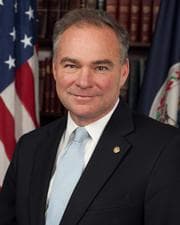
Tim Kaine
Democrat · Senator for Virginia
111 sponsored · 523 cosponsored
In the Senate since 2013
Age 68
Contact their office: (202) 224-4024 · 231 Russell Senate Office Building, Washington, DC 20510 · Official website
In the 119th Congress (2025–2026)
- Sponsored 111 bills.The typical senator sponsored 61. Bills they wrote, not ones they signed on to.
- 2 bills they backed became law.1 they wrote, 1 they cosponsored.
- 17 passed the Senate and wait on the House.And 1 has passed both chambers and gone to the President.
- Missed 11 of 915 recorded votes (1.2%).The typical senator missed 2.2%. The record doesn’t say why.
- Works most on international affairs and health.158 and 62 of the 634 bills they wrote or backed.
What they got done
Most bills never get a vote. These are the ones they wrote or backed that got somewhere.
Became law (2)
- Their billA bill to designate the General George C. Marshall House, in the Commonwealth of Virginia, as an affiliated area of the National Park System, and for other purposes.Sep 25, 2026
This bill designates the General George C. Marshall House in Virginia as an affiliated area of the National Park System. The goal is to help people appreciate the historic contributions of George Catlett Marshall, Jr.
Became law · 119-S-603
This Act directs the Federal Communications Commission to take specific action regarding emergency notifications.
Became law · 119-S-1003
- Yes: Does this improve help for people hit by a disaster?The expansion of wireless emergency alerts for shark attacks enhances public safety during natural or environmental emergencies. +5
Passed Congress — the President's turn (1)
Both chambers passed it. The President signs it into law or vetoes it, and a veto stands unless two-thirds of each chamber vote to pass it anyway. Everything Congress has sent the President →
This bill amends the Employee Retirement Income Security Act of 1974. The main purpose is to provide a clear definition of adequate consideration for certain closely held stock.
The President has until Friday, October 16 to sign it or veto it — 3 days from today.
Sent to the President · 119-S-2403
- Yes: Would people over 65 be better off under this?The act benefits retirees by clarifying the valuation process for employee stock ownership plans. +4
Passed one chamber, waiting on the other (17)
Halfway: the other chamber has to pass the same text before it can go to the President.
- Their billA joint resolution terminating the national emergency declared to impose duties on articles imported from Canada.Oct 29, 2025
This joint resolution puts an end to the national emergency declared on February 1, 2025, by the President in Executive Order 14193.
Passed the Senate 50–46 · 119-SJRES-77
- Yes: Does this make trade with other countries easier?Removing the national emergency directly eliminates the duties imposed on articles imported from Canada, boosting cross-border trade. +6
- No: Does this give the federal government more power?The resolution exercises legislative authority to check executive emergency powers. -3
- Their billA joint resolution terminating the national emergency declared to impose duties on articles imported from Brazil.Oct 28, 2025
This is a joint resolution passed by the Senate on October 28, 2025. The resolution seeks to terminate a national emergency that was previously declared by the President.
Passed the Senate 52–48 · 119-SJRES-81
- Yes: Does this make trade with other countries easier?The resolution removes the import duties on articles from Brazil, thereby easing trade barriers. +5
- Their billA joint resolution terminating the national emergency declared to impose duties on articles imported from Canada.Apr 2, 2025
This joint resolution seeks to terminate a specific national emergency. The emergency was originally declared by the President on February 1, 2025, via Executive Order 14193.
Passed the Senate 51–48 · 119-SJRES-37
And 14 more on their Sponsored and Cosponsored pages.
Resolutions of theirs that were adopted (2)
A resolution is a chamber speaking for itself — a position, a rule or a tribute. Adopting it puts it into effect, but it is not a law.
Still waiting, of the 111 bills they wrote: 9 cleared committee and wait for a first vote, 94 are in committee, 2 were stopped. Committee is where most bills end, whoever writes them — silence there, not a vote, is the usual way a bill dies.
What their bills would do
Every bill is scored against plain yes-or-no questions. These count their bills — the ones they wrote and the ones they cosponsored — by how each question was answered: yes, or the opposite. Open one to see those bills, where each stands, and why it was scored that way. Scores are made by AI ().
Who their bills would affect
What else they would change
How they voted lately
Their latest votes that decided something, and what each measure would do.
This bill sets national rules for student athlete name, image, and likeness rights. It creates protections for academic progress, medical coverage, and health and safety standards.
The vote on whether to pass the bill — Bill Passed
- Yes: Would people in their twenties and thirties be better off under this?Significantly expands earning potential through NIL rights and provides medical and academic protections for college athletes. +9
- No: Does this leave more decisions to the states?Prevents states from enforcing their own NIL compensation and transfer laws that conflict with the federal framework. -5
119-S-4668 · roll call 250
What the Amendment Does As folks looking out for the good of the people and holding our officials accountable, we need to know what our leaders are trying to change. This amendment, submitted by Mr. Booker and Mr.
A vote on a proposed change to the bill — Amendment Rejected
119-SAMDT-6835 · roll call 249
- YeaTo increase the limitation on funding for post-eligibility insurance and catastrophic injury for student athletes.Sep 29, 2026
What the Amendment Does Mr. Booker, along with Mr. Blumenthal, submitted this amendment to change how a specific fund or program is paid for in the bill.
A vote on a proposed change to the bill — Amendment Rejected
119-SAMDT-6805 · roll call 248
On the President’s nominees
The President chooses federal judges, cabinet secretaries, ambassadors and military officers, and the Senate decides whether each one gets the job. Most are confirmed by voice vote, which records no one’s position; in the 119th Congress (2025–2026) the Senate put 223 confirmations to a recorded vote, and confirmed every one.
They voted to confirm 45 and against 177, and did not vote on 1. Those votes covered 592 nominees, because the Senate sometimes confirms many in a single vote.
The 5 most recent they voted against
Keith Sonderling, of Florida, to be Secretary of Labor, vice Lori Chavez-DeRemer, resigned.
Nomination Confirmed 47–41 · Sep 30, 2026
Angela Veronica Colmenero, of Texas, to be United States District Judge for the Southern District of Texas, vice Lee H. Rosenthal, retired.
Nomination Confirmed 50–47 · Sep 23, 2026
Kasdin Miller Mitchell, of Texas, to be United States District Judge for the Northern District of Texas, vice Barbara M. Lynn, retired.
Nomination Confirmed 49–45 · Sep 17, 2026
Matthew R. Byrne, of Ohio, to be United States District Judge for the Southern District of Ohio, vice Michael H. Watson, retired.
Nomination Confirmed 52–45 · Sep 15, 2026
Todd Blanche, of Florida, to be Attorney General, vice Pamela Bondi.
Nomination Confirmed 50–49 · Aug 8, 2026
How busy they have been
How many bills they have put their name to over time — volume, not results: most bills never get a vote.