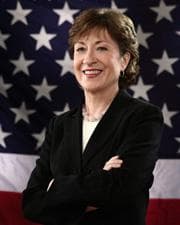

Susan M. Collins

Susan M. Collins

Republican · U.S. Senator for Maine

31 sponsored · 341 cosponsored

Age 74 · In office since 1997

Contact their office: (202) 224-2523 · 413 Dirksen Senate Office Building, Washington, DC 20510 · Official website

What they got done

Most bills never get a vote. These are the ones they wrote or backed that got somewhere.

Became law (4)

  • Susan Collins (R-ME)

    Their bill

    Kay Hagan Tick Reauthorization Act

    S. 2398 Health

    A Republican bill with 15 Democratic cosponsors.

    Became law

    This bill is designed to reauthorize specific programs related to vector-borne diseases. The legislation amends the Public Health Service Act to update the timeline for several provisions.

    Yes· 2 of 11

    • Scored +3

      Does this make the country readier for the next outbreak?

      The bill enhances support for health departments and regional centers that address vector-borne diseases, improving pandemic preparedness related to those diseases.

    • Scored +2

      Would children be better off under this?

      Preventing and treating vector-borne diseases has a small positive impact on children's health.

    No question was scored the opposite.

  • Roger Marshall (R-KS)

    Cosponsored

    Whole Milk for Healthy Kids Act of 2025

    S. 222 Agriculture and Food

    A Republican bill with 5 Democratic cosponsors.

    Became law

    This bill aims to amend the Richard B. Russell National School Lunch Act. This legislation allows schools participating in the school lunch program to offer whole milk, whether organic or non-organic.

    Yes· 2 of 6

    • Scored +5

      Would children be better off under this?

      The bill increases the variety of milk options available to students and enhances food allergy safety training for schools.

    • Scored +5

      Would students be better off under this?

      Students benefit from expanded milk choices and improved food allergy safety protocols in their schools.

    No question was scored the opposite.

  • Bill Cassidy (R-LA)

    Cosponsored

    HALT Fentanyl Act

    S. 331 Crime and Law Enforcement

    A Republican bill with 6 Democratic cosponsors. See the voting map.

    Became law

    The House voted 321–104 on Jun 12.

    This bill permanently places all fentanyl-related substances into schedule I of the Controlled Substances Act.

    Yes· 2 of 9

    • Scored +6

      Does this do more about addiction and overdose deaths?

      The act directly attempts to combat the fentanyl crisis by increasing penalties and attempting to decrease availablity.

    • Scored +3

      Does this put more money into scientific research?

      Streamlining research registration may indirectly incentivize funding for scientific research related to fentanyl and other schedule I substances.

    The opposite· 2 of 10

    • Scored -3

      Does this shorten or soften prison sentences?

      Increased penalties for fentanyl-related substances could lead to longer prison sentences, hindering criminal sentencing reform efforts.

    • Scored -2

      Would households on low incomes be better off under this?

      Increased penalties could disproportionately affect low-income households due to the higher likelihood of being involved in the criminal justice system.

And 1 more on their Sponsored and Cosponsored pages.

Passed Congress — the President's turn (1)

Both chambers passed it. The President signs it into law or vetoes it, and a veto stands unless two-thirds of each chamber vote to pass it anyway. Everything Congress has sent the President →

  • Jerry Moran (R-KS)

    Cosponsored

    Fallen Servicemembers Religious Heritage Restoration Act

    S. 1318 Armed Forces and National Security

    A Republican bill with 11 Democratic cosponsors. See the voting map.

    Passed both chambers

    235191

    This bill consists of two main parts: the Foreign Intelligence Accountability Act and the Anti-CBDC Surveillance State Act.

    Yes· 2 of 5

    • Scored +8

      Does this protect people from being watched or searched?

      The bill strengthens protections against government surveillance and prevents the implementation of a central bank digital currency.

    • Scored +7

      Does this give people more control over their personal data?

      The bill implements stricter oversight on government access to personal data and prohibits central bank digital currency implementation.

    The opposite

    • Scored -5

      Does this give the government more power to monitor people inside the country?

      The bill acts to restrict and curb the expansion of domestic surveillance capabilities of the Federal Reserve and FBI.

    • Scored -3

      Does this give the federal government more power?

      The bill limits the expansion of federal authority regarding digital currency and surveillance.

Passed one chamber, waiting on the other (17)

Halfway: the other chamber has to pass the same text before it can go to the President.

  • Susan Collins (R-ME)

    Their bill

    Improving Access to Workers’ Compensation for Injured Federal Workers Act of 2025

    S. 3296 Government Operations and Politics

    A Republican bill with 8 Democratic cosponsors.

    Passed the Senate

    With no one objecting, no names recorded

    Now: kept ready for the floor instead of being sent to a committee · Nov 17

    This bill changes the rules so that nurse practitioners and physician assistants are included in the workers' compensation coverage for injured federal workers.

    Yes

    • Scored +5

      Does this make health care easier to get in general?

      Increases access to care for injured federal workers by allowing nurse practitioners and physician assistants to provide covered services.

    • Scored +1

      Would hourly workers be better off under this?

      The bill expands the range of eligible medical providers available to federal workers under workers' compensation.

    No question was scored the opposite.

  • Susan Collins (R-ME)

    Their bill

    District of Columbia Local Funds Act, 2025

    S. 1077 Economics and Public Finance

    A Republican bill with 6 Democratic cosponsors.

    Passed the Senate

    By voice vote, no names recorded

    Now: kept ready for the floor instead of being sent to a committee · Mar 18

    This Act approves local funds for the District of Columbia for fiscal year 2025.

    Yes

    • Scored +2

      Would people in cities be better off under this?

      The bill provides continued funding for District of Columbia local programs and services.

    • Scored +1

      Does this make the government pay for what it commits to?

      The bill enforces budget ceilings and restricts the use of capital funds for operating expenses.

    No question was scored the opposite.

  • Jim Banks (R-IN)

    Cosponsored

    RISE Act

    S. 3589 Education

    A Republican bill with 6 Democratic cosponsors.

    Passed the Senate

    By voice vote, no names recorded

    Now: kept ready for the floor instead of being sent to a committee · Nov 12

    This bill is known as the RISE Act and amends the Higher Education Act of 1965 to help students with disabilities succeed in college.

    Yes· 2 of 5

    • Scored +8

      Would people with disabilities be better off under this?

      The bill mandates more transparent accommodation processes, provides clearer documentation paths, and funds a national support center.

    • Scored +7

      Does this expand the rights of people with disabilities?

      The bill requires institutions to adopt clearer, more accessible documentation policies and transparent processes for students seeking accommodations.

    No question was scored the opposite.

And 14 more on their Sponsored and Cosponsored pages.

Resolutions of theirs that were adopted (8)

A resolution is a chamber speaking for itself — a position, a rule or a tribute. Adopting it puts it into effect, but it is not a law.

Still waiting, of the 31 bills they wrote: 20 are in committee. Committee is where most bills end, whoever writes them — silence there, not a vote, is the usual way a bill dies.

What their bills would do

Every bill is scored against plain yes-or-no questions. These count their bills — the ones they wrote and the ones they cosponsored — by how each question was answered: yes, or the opposite. Open one to see those bills, where each stands, and why it was scored that way. Scores are made by AI ().

Who their bills would affect

What else they would change

How they voted lately

Their latest votes that decided something, and what each measure would do.

  • U.S. Senate · Nov 20, 2026

    Bipartisan American Affordability and Jobs Act of 2026

    The vote on whether to pass the bill This is the real decision in this chamber. Passing here sends the bill to the other chamber, which must pass it too before it can go to the President.

    Their vote Yea

    This bill aims to accelerate energy projects and infrastructure development by reforming federal environmental reviews, permitting procedures, and court review rules.

    • Scored +5

      Would women be better off under this?

      By protecting settlement money from taxation, the bill provides greater financial security for women survivors of sexual violence.

  • U.S. Senate · Nov 19, 2026

    Directing the President, pursuant to section 5(c) of the War Powers Resolution, to remove United States Armed Forces from hostilities with Iran.

    The vote on whether to adopt the resolution A resolution is one chamber speaking for itself — setting its own rules, taking a position, honouring someone — and it never goes to the President. Agreeing to it is the whole decision.

    Their vote Yea

    This resolution directs the President to remove United States Armed Forces from hostilities with Iran. It uses the authority found under section 5(c) of the War Powers Resolution.

    • Scored +4

      Does this favour talking over confrontation abroad?

      Ending hostilities can pave the way for diplomatic resolutions between the US and Iran.

    • Scored -5

      Does this give the federal government more power?

      The bill limits the Executive branch's power to engage in military hostilities without Congressional approval.

  • U.S. Senate · Nov 18, 2026

    In the nature of a substitute.

    A vote on a proposed change to the bill A vote on one change, not on the bill. A bill can collect dozens of these, and losing one does not stop it.

    Their vote Yea

    This amendment amends the Internal Revenue Code of 1986 to exclude from gross income any damages, other than punitive damages, received on account of sexual acts or sexual contact.

Every vote they cast, and how often they missed one →

On the President’s nominees

The President chooses federal judges, cabinet secretaries, ambassadors and military officers, and the Senate decides whether each one gets the job. Most are confirmed by voice vote, which records no one’s position. In the 119th Congress (2025–2026) the Senate put 228 confirmations to a recorded vote, and confirmed every one.

Their votes to confirm, of 228 recorded votes

  • Yes: 221
  • No: 7
  • Missed: None

Those votes covered 598 nominees, because the Senate sometimes confirms many in a single vote.

The 5 most recent they voted against

How busy they have been

How many bills they have put their name to over time — volume, not results: most bills never get a vote.

Legislative activity over time