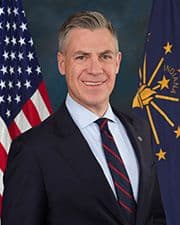
Jim Banks
Republican · Senator for Indiana
107 sponsored · 263 cosponsored
In the Senate since 2025, in Congress since 2017
Age 47
Contact their office: (202) 224-4814 · 303 Hart Senate Office Building, Washington, DC 20510 · Official website
In the 119th Congress (2025–2026)
- Sponsored 107 bills.The typical senator sponsored 61. Bills they wrote, not ones they signed on to.
- 5 bills they backed became law.They cosponsored them.
- 9 passed the Senate and wait on the House.And 1 has passed both chambers and gone to the President.
- Missed 12 of 915 recorded votes (1.3%).The typical senator missed 2.2%. The record doesn’t say why.
- Works most on armed forces and national security and health.59 and 52 of the 370 bills they wrote or backed.
What they got done
Most bills never get a vote. These are the ones they wrote or backed that got somewhere.
Became law (5)
This bill is designed to reauthorize specific programs related to vector-borne diseases. The legislation amends the Public Health Service Act to update the timeline for several provisions.
Became law · 119-S-2398
- Yes: Does this make the country readier for the next outbreak?The bill enhances support for health departments and regional centers that address vector-borne diseases, improving pandemic preparedness related to those diseases. +3
This Act aims to increase compensation rates for various groups.
Became law · 119-S-2392
- Yes: Does this increase the pay, pensions or support veterans receive?The bill mandates an increase in disability compensation, clothing allowances, and dependency compensation for veterans and their families. +7
This bill directs the Secretary of Veterans Affairs to partner with the National Academies of Sciences, Engineering, and Medicine to conduct a specific study.
Became law · 119-S-201
- Yes: Would veterans be better off under this, taking everything together?The bill directly investigates health risks faced by former active duty aircrew members. +6
And 2 more on their Sponsored and Cosponsored pages.
Passed Congress — the President's turn (1)
Both chambers passed it. The President signs it into law or vetoes it, and a veto stands unless two-thirds of each chamber vote to pass it anyway. Everything Congress has sent the President →
This bill consists of two main parts: the Foreign Intelligence Accountability Act and the Anti-CBDC Surveillance State Act.
Passed the House 235–191 · 119-S-1318
- Yes: Does this protect people from being watched or searched?The bill strengthens protections against government surveillance and prevents the implementation of a central bank digital currency. +8
- No: Does this give the government more power to monitor people inside the country?The bill acts to restrict and curb the expansion of domestic surveillance capabilities of the Federal Reserve and FBI. -5
Passed one chamber, waiting on the other (9)
Halfway: the other chamber has to pass the same text before it can go to the President.
This Act directs the Secretary of Health and Human Services to conduct a comprehensive study regarding fentanyl testing in hospital emergency departments.
Passed the Senate with no one objecting, no names recorded · 119-S-921
- Yes: Does this do more about addiction and overdose deaths?By investigating routine fentanyl testing, the bill aims to better manage and respond to overdose incidents. +6
This bill extends the Terrorism Risk Insurance Act of 2002 by seven years. The new termination date for the program is changed from 2027 to 2034.
Passed the Senate with no one objecting, no names recorded · 119-S-4395
- Yes: Is this likely to grow the economy?Extending the Terrorism Risk Insurance Program provides stability and confidence for commercial real estate and business investments. +3
- They cosponsoredAccelerating Access to Critical Therapies for ALS Reauthorization Act of 2026Aug 4, 2026
This Act aims to extend the provisions of the Accelerating Access to Critical Therapies for ALS Act. It reauthorizes specific provisions through fiscal year 2031.
Passed the Senate by voice vote, no names recorded · 119-S-4472
- Yes: Would people with disabilities be better off under this?The bill supports the development of therapies for ALS, a debilitating neurodegenerative disease. +5
And 6 more on their Sponsored and Cosponsored pages.
Resolutions of theirs that were adopted (1)
A resolution is a chamber speaking for itself — a position, a rule or a tribute. Adopting it puts it into effect, but it is not a law.
Still waiting, of the 107 bills they wrote: 4 cleared committee and wait for a first vote, 101 are in committee. Committee is where most bills end, whoever writes them — silence there, not a vote, is the usual way a bill dies.
What their bills would do
Every bill is scored against plain yes-or-no questions. These count their bills — the ones they wrote and the ones they cosponsored — by how each question was answered: yes, or the opposite. Open one to see those bills, where each stands, and why it was scored that way. Scores are made by AI ().
Who their bills would affect
What else they would change
How they voted lately
Their latest votes that decided something, and what each measure would do.
This bill sets national rules for student athlete name, image, and likeness rights. It creates protections for academic progress, medical coverage, and health and safety standards.
The vote on whether to pass the bill — Bill Passed
- Yes: Would people in their twenties and thirties be better off under this?Significantly expands earning potential through NIL rights and provides medical and academic protections for college athletes. +9
- No: Does this leave more decisions to the states?Prevents states from enforcing their own NIL compensation and transfer laws that conflict with the federal framework. -5
119-S-4668 · roll call 250
What the Amendment Does As folks looking out for the good of the people and holding our officials accountable, we need to know what our leaders are trying to change. This amendment, submitted by Mr. Booker and Mr.
A vote on a proposed change to the bill — Amendment Rejected
119-SAMDT-6835 · roll call 249
- NayTo increase the limitation on funding for post-eligibility insurance and catastrophic injury for student athletes.Sep 29, 2026
What the Amendment Does Mr. Booker, along with Mr. Blumenthal, submitted this amendment to change how a specific fund or program is paid for in the bill.
A vote on a proposed change to the bill — Amendment Rejected
119-SAMDT-6805 · roll call 248
On the President’s nominees
The President chooses federal judges, cabinet secretaries, ambassadors and military officers, and the Senate decides whether each one gets the job. Most are confirmed by voice vote, which records no one’s position; in the 119th Congress (2025–2026) the Senate put 223 confirmations to a recorded vote, and confirmed every one.
They voted to confirm 220 and against none, and did not vote on 3. Those votes covered 543 nominees, because the Senate sometimes confirms many in a single vote.
How busy they have been
How many bills they have put their name to over time — volume, not results: most bills never get a vote.