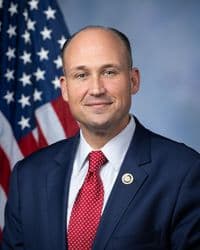
Nicholas A. Langworthy
Republican · Representative for New York's 23rd district
50 sponsored · 331 cosponsored
In the House since 2023
Age 45
Contact their office: (202) 225-3161 · 422 Cannon House Office Building, Washington, DC 20515 · Official website
In the 119th Congress (2025–2026)
- Sponsored 50 bills.The typical House member sponsored 25. Bills they wrote, not ones they signed on to.
- 7 bills they backed became law.They cosponsored them.
- 44 passed the House and wait on the Senate.The Senate has to pass the same text before it can become law.
- Missed 11 of 676 recorded votes (1.6%).The typical House member missed 1.9%. The record doesn’t say why.
- Works most on health and crime and law enforcement.68 and 42 of the 381 bills they wrote or backed.
What they got done
Most bills never get a vote. These are the ones they wrote or backed that got somewhere.
Became law (7)
This bill amends the Federal Power Act to require the Federal Energy Regulatory Commission to submit a yearly report to Congress.
Became law · 119-HR-3657
- Yes: Does this make what the government does easier for the public to see?The act mandates annual public reports to Congress to increase transparency in the hydropower licensing process. +5
This Act authorizes the award of 3 Congressional Gold Medals to the members of the 1980 U.S. Olympic Men's Ice Hockey Team. The medals recognize the team's victory over the Soviet Union during the 1980 Winter Olympics.
Became law · 119-HR-452
This joint resolution states that Congress disapproves of a specific rule submitted by the Environmental Protection Agency.
Became law · 119-HJRES-89
- Yes: Does this leave more decisions to the states?The resolution supports state-level control by nullifying federal oversight of the EPA rule. +3
- No: Does this better protect air, water and wildlife?Disapproving the EPA rule weakens existing environmental standards for motor vehicle pollution. -4
And 4 more on their Sponsored and Cosponsored pages.
Passed one chamber, waiting on the other (44)
Halfway: the other chamber has to pass the same text before it can go to the President.
This bill updates the Northern Border Security Review Act by requiring regular updates to threat analysis and border strategies.
Passed the House by voice vote, no names recorded · 119-HR-5517
- Yes: Does this tighten control of the border?The bill enhances security through mandated strategy updates and performance measures for air and maritime environments. +5
This bill aims to amend the Energy Conservation and Production Act. It seeks to repeal specific Federal building energy efficiency performance standards.
Passed the House 215–202 · 119-HR-4690
- No: Does this cut the pollution that drives climate change?The bill repeals energy efficiency standards and allows buildings to use fossil fuels while still receiving green certifications. -5
This bill amends chapter 3 of title 36, United States Code. The purpose of the bill is to officially designate certain prehistoric creatures. Specifically, it names the American mastodon as the national fossil mammal.
Passed the House by voice vote, no names recorded · 119-HR-9191
And 41 more on their Sponsored and Cosponsored pages.
Resolutions of theirs that were adopted (7)
A resolution is a chamber speaking for itself — a position, a rule or a tribute. Adopting it puts it into effect, but it is not a law.
- Providing for consideration of the bill (H.R. 8312) to establish fraud prevention and program integrity functions and data sharing authorities within the Department of Treasury and a permanent governmentwide Inspector General for Fraud, Accountability, and Recovery, and for other purposes; providing for consideration of the bill (H.R. 8464) to amend title 31, United States Code, to authorize pausing and segmenting payments, and for other purposes; providing for consideration of the resolution (H. Res. 1335) condemning actors seeking to defraud the United States Government, and expressing the sense of the House of Representatives that governmentwide fraud and improper payment prevention reforms will meaningfully improve the financial prosperity of the United States, and that Federal program eligibility should be verified before payment; and providing for consideration of the bill (S. 2) to provide for reconciliation pursuant to title II of S. Con. Res. 33.
- Electing Members to certain standing committees of the House of Representatives.
- Providing for consideration of the bill (H.R. 6387) to amend the Clean Air Act to require revisions to regulations governing the review and handling of air quality monitoring data influenced by exceptional events or actions to mitigate wildfire risk; providing for consideration of the bill (H.R. 6398) to amend the Clean Air Act relating to review by the Environmental Protection Agency of proposed legislation; providing for consideration of the bill (H.R. 6409) to amend the Clean Air Act to clarify standards for emissions emanating from outside of the United States, and for other purposes; and providing for consideration of the resolution (H. Res. 1156) expressing support for tax policies that support working families.
- Providing for consideration of the bill (H.R. 4776) to amend the National Environmental Policy Act of 1969 to clarify ambiguous provisions and facilitate a more efficient, effective, and timely environmental review process; providing for consideration of the bill (H.R. 1366) to provide for the location of multiple hardrock mining mill sites, to establish the Abandoned Hardrock Mine Fund, and for other purposes; providing for consideration of the bill (H.R. 845) to require the Secretary of the Interior to reissue regulations removing the gray wolf from the list of endangered and threatened wildlife under the Endangered Species Act of 1973; providing for consideration of the bill (H.R. 3616) to require the Federal Energy Regulatory Commission to review regulations that may affect the reliable operation of the bulk-power system; providing for consideration of the bill (H.R. 3632) to amend the Federal Power Act to adjust the requirements for orders, rules, and regulations relating to furnishing adequate service, to require owners or operators of generating facilities to provide notice of planned retirements of certain electric generating units, and for other purposes; and providing for consideration of the bill (H.R. 4371) to amend the William Wilberforce Trafficking Victims Protection Reauthorization Act of 2008 to enhance efforts to combat the trafficking of children.
- Providing for consideration of the bill (H.R. 4922) to limit youth offender status in the District of Columbia to individuals 18 years of age or younger, to direct the Attorney General of the District of Columbia to establish and operate a publicly accessible website containing updated statistics on juvenile crime in the District of Columbia, to amend the District of Columbia Home Rule Act to prohibit the Council of the District of Columbia from enacting changes to existing criminal liability sentences, and for other purposes; providing for consideration of the bill (H.R. 5143) to establish standards for law enforcement officers in the District of Columbia to engage in vehicular pursuits of suspects, and for other purposes; providing for consideration of the bill (H.R. 5140) to lower the age at which a minor may be tried as an adult for certain criminal offenses in the District of Columbia to 14 years of age; providing for consideration of the bill (H.R. 5125) to amend the District of Columbia Home Rule Act to terminate the District of Columbia Judicial Nomination Commission, and for other purposes; providing for consideration of the bill (H.R. 1047) to require the Federal Energy Regulatory Commission to reform the interconnection queue process for the prioritization and approval of certain projects, and for other purposes; providing for consideration of the bill (H.R. 3015) to reestablish the National Coal Council in the Department of Energy to provide advice and recommendations to the Secretary of Energy on matters related to coal and the coal industry, and for other purposes; providing for consideration of the bill (H.R. 3062) to establish a more uniform, transparent, and modern process to authorize the construction, connection, operation, and maintenance of international border-crossing facilities for the import and export of oil and natural gas and the transmission of electricity; and for other purposes.
- Providing for consideration of the joint resolution (S.J. Res. 13) providing for congressional disapproval under chapter 8 of title 5, United States Code, of the rule submitted by the Office of the Comptroller of the Currency of the Department of the Treasury relating to the review of applications under the Bank Merger Act; providing for consideration of the joint resolution (S.J. Res. 31) providing for congressional disapproval under chapter 8 of title 5, United States Code, of the rule submitted by the Environmental Protection Agency relating to "Review of Final Rule Reclassification of Major Sources as Area Sources Under Section 112 of the Clean Air Act"; and waiving a requirement of clause 6(a) of rule XIII with respect to consideration of certain resolutions reported from the Committee on Rules.
- Providing for consideration of the joint resolution (H.J. Res. 42) providing for congressional disapproval under chapter 8 of title 5, United States Code, of the rule submitted by the Department of Energy relating to "Energy Conservation Program for Appliance Standards: Certification Requirements, Labeling Requirements, and Enforcement Provisions for Certain Consumer Products and Commercial Equipment"; providing for consideration of the joint resolution (H.J. Res. 61) providing for congressional disapproval under chapter 8 of title 5, United States Code, of the rule submitted by the Environmental Protection Agency relating to "National Emission Standards for Hazardous Air Pollutants: Rubber Tire Manufacturing"; and providing for consideration of the joint resolution (S.J. Res. 11) providing for congressional disapproval under chapter 8 of title 5, United States Code, of the rule submitted by the Bureau of Ocean Energy Management relating to "Protection of Marine Archaeological Resources".
Still waiting, of the 50 bills they wrote: 2 cleared committee and wait for a first vote, 38 are in committee, 1 was stopped. Committee is where most bills end, whoever writes them — silence there, not a vote, is the usual way a bill dies.
What their bills would do
Every bill is scored against plain yes-or-no questions. These count their bills — the ones they wrote and the ones they cosponsored — by how each question was answered: yes, or the opposite. Open one to see those bills, where each stands, and why it was scored that way. Scores are made by AI ().
Who their bills would affect
What else they would change
How they voted lately
Their latest votes that decided something, and what each measure would do.
This bill amends the Employee Retirement Income Security Act of 1974. The main purpose is to provide a clear definition of adequate consideration for certain closely held stock.
A fast-track vote, needing two-thirds to pass — Passed
- Yes: Would retired people be better off under this?Improving the clarity of stock valuation for ESOPs supports more stable retirement transitions. +4
119-S-2403 · roll call 314
This Act provides for improvements to rivers and harbors in the United States and the conservation and development of water and related resources.
A fast-track vote, needing two-thirds to pass — Passed
- Yes: Would Native Americans be better off under this?Directly authorizes land transfers to Tribal entities and prioritizes technical assistance for Tribal communities. +8
- No: Does this reduce what the federal government spends?The bill explicitly increases spending limits and funding authorizations for dozens of regional water resource programs. -5
119-HR-9497 · roll call 313
This bill amends the Public Utility Regulatory Policies Act of 1978 to create a new Federal standard regarding the costs of upgrades for large-load customers.
A fast-track vote, needing two-thirds to pass — Passed
- Yes: Does this keep data centers from raising household electric and water bills?The bill requires large-load customers to cover the full incremental cost of grid upgrades and provide financial assurances, preventing those costs from being passed to households. +7
- No: Would business owners be better off under this?Large-scale non-residential energy consumers face increased costs and financial assurance requirements. -5
119-HR-9340 · roll call 312
On the President’s vetoes
The President can refuse to sign a bill both chambers passed. It becomes law anyway only if two-thirds of the House and two-thirds of the Senate vote to pass it again. A vote against the veto (a Yea) was a vote to make the bill law over the President’s objection; a vote for it (a Nay) was a vote to let the veto stand.
Finish the Arkansas Valley Conduit Act — vetoed Dec 29, 2025
For the vetovoted Nay, to let the veto stand.
The override fell short in the House, 248–177; it needed two-thirds · Jan 8, 2026
Miccosukee Reserved Area Amendments Act — vetoed Dec 29, 2025
For the vetovoted Nay, to let the veto stand.
The override fell short in the House, 236–188; it needed two-thirds · Jan 8, 2026
How busy they have been
How many bills they have put their name to over time — volume, not results: most bills never get a vote.