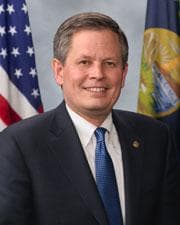
Steve Daines
Republican · Senator for Montana
66 sponsored · 355 cosponsored
In the Senate since 2015, in Congress since 2013
Age 64
Contact their office: (202) 224-2651 · 320 Hart Senate Office Building, Washington, DC 20510 · Official website
In the 119th Congress (2025–2026)
- Sponsored 66 bills.The typical senator sponsored 61. Bills they wrote, not ones they signed on to.
- 8 bills they backed became law.1 they wrote, 7 they cosponsored.
- 9 passed the Senate and wait on the House.And 1 has passed both chambers and gone to the President.
- Missed 26 of 915 recorded votes (2.8%).The typical senator missed 2.2%. The record doesn’t say why.
- Works most on health and crime and law enforcement.61 and 36 of the 421 bills they wrote or backed.
What they got done
Most bills never get a vote. These are the ones they wrote or backed that got somewhere.
Became law (8)
- Their billA bill to require the Federal Energy Regulatory Commission to extend the time period during which licensees are required to commence construction of certain hydropower projects.May 11, 2026
This bill directs the Federal Energy Regulatory Commission to extend the timeframe for starting construction on certain hydropower projects.
Became law · 119-S-1020
- Yes: Would business owners be better off under this?The bill benefits energy company owners by providing more time to commence construction and a mechanism to reinstate expired licenses. +5
This bill aims to extend the Secure Rural Schools and Community Self-Determination Act of 2000. It extends various deadlines and years within the original act, such as changing certain dates from 2023 to 2026.
Became law · 119-S-356
- Yes: Would people in rural areas be better off under this?The bill directly extends financial payments and project authority to rural counties containing federal land. +5
This Act amends existing law regarding the screening of infant nutrition.
Became law · 119-S-260
- Yes: Would children be better off under this?The act protects infants by ensuring the hygienic handling of breast milk and formula during travel. +5
And 5 more on their Sponsored and Cosponsored pages.
Passed Congress — the President's turn (1)
Both chambers passed it. The President signs it into law or vetoes it, and a veto stands unless two-thirds of each chamber vote to pass it anyway. Everything Congress has sent the President →
This bill makes changes to the Crow Tribe Water Rights Settlement Act of 2010. The legislation updates definitions and repeals the old MR&I System.
The President has until Friday, October 16 to sign it or veto it — 3 days from today.
Sent to the President · 119-S-240
- Yes: Would Native Americans be better off under this?Directly provides funding and legal mechanisms for the Crow Tribe's water rights and infrastructure. +10
Passed one chamber, waiting on the other (9)
Halfway: the other chamber has to pass the same text before it can go to the President.
This bill amends the Homeowner Flood Insurance Affordability Act of 2014 to specifically address ecosystem restoration projects.
Passed the Senate with no one objecting, no names recorded · 119-S-1564
- Yes: Does this better protect air, water and wildlife?The bill facilitates ecosystem restoration projects to recover or enhance natural functions of aquatic resources and floodplains. +5
This bill extends the Terrorism Risk Insurance Act of 2002 by seven years. The new termination date for the program is changed from 2027 to 2034.
Passed the Senate with no one objecting, no names recorded · 119-S-4395
- Yes: Would business owners be better off under this?Business owners benefit from the extended availability and affordability of terrorism risk insurance coverage. +3
S. 3257, known as the John A. Hauser Mental Health in Aviation Act, directs the Federal Aviation Administration (FAA) Administrator to update regulations and guidance regarding individuals in aviation who disclose menta…
Passed the Senate with no one objecting, no names recorded · 119-S-3257
- Yes: Does this make mental health care easier to get?Encourages aviation personnel to seek mental health help and streamlines the medical certification process for those receiving treatment. +7
And 6 more on their Sponsored and Cosponsored pages.
Resolutions of theirs that were adopted (13)
A resolution is a chamber speaking for itself — a position, a rule or a tribute. Adopting it puts it into effect, but it is not a law.
- A resolution honoring 35 years of independence for the countries of Central Asia and recognizing the importance of the United States growing relationship with Kazakhstan, Kyrgyzstan, Tajikistan, Turkmenistan, and Uzbekistan.
- A resolution designating the week of August 22 through August 30, 2026, as "National Park Week".
- A resolution designating June 2026 as "Great Outdoors Month".
- A resolution commemorating the 150th anniversary of the Battle of the Little Bighorn.
- A resolution designating May 2026 as "National Brain Tumor Awareness Month".
- A resolution expressing support for the designation of May 5, 2026, as "National Day of Awareness for Missing and Murdered Indigenous Women and Girls".
- A resolution congratulating the Montana State University football team for winning the 2025 Division I Football Championship Subdivision Championship.
- A resolution honoring the strategic importance of the C5+1 diplomatic platform and recognizing the deepening partnership between the United States and the nations of Kazakhstan, Kyrgyzstan, Tajikistan, Turkmenistan, and Uzbekistan.
- A resolution recognizing and celebrating 100 years of quantum mechanics.
- A resolution designating June 2025 as "Great Outdoors Month".
- A resolution designating May 2025 as "National Brain Tumor Awareness Month".
- A resolution expressing support for the designation of May 5, 2025, as the "National Day of Awareness for Missing and Murdered Indigenous Women and Girls".
- A resolution designating the week of April 19 through April 27, 2025, as "National Park Week".
Still waiting, of the 66 bills they wrote: 6 cleared committee and wait for a first vote, 45 are in committee. Committee is where most bills end, whoever writes them — silence there, not a vote, is the usual way a bill dies.
What their bills would do
Every bill is scored against plain yes-or-no questions. These count their bills — the ones they wrote and the ones they cosponsored — by how each question was answered: yes, or the opposite. Open one to see those bills, where each stands, and why it was scored that way. Scores are made by AI ().
Who their bills would affect
What else they would change
How they voted lately
Their latest votes that decided something, and what each measure would do.
This bill sets national rules for student athlete name, image, and likeness rights. It creates protections for academic progress, medical coverage, and health and safety standards.
The vote on whether to pass the bill — Bill Passed
- Yes: Would people in their twenties and thirties be better off under this?Significantly expands earning potential through NIL rights and provides medical and academic protections for college athletes. +9
- No: Does this leave more decisions to the states?Prevents states from enforcing their own NIL compensation and transfer laws that conflict with the federal framework. -5
119-S-4668 · roll call 250
What the Amendment Does As folks looking out for the good of the people and holding our officials accountable, we need to know what our leaders are trying to change. This amendment, submitted by Mr. Booker and Mr.
A vote on a proposed change to the bill — Amendment Rejected
119-SAMDT-6835 · roll call 249
- NayTo increase the limitation on funding for post-eligibility insurance and catastrophic injury for student athletes.Sep 29, 2026
What the Amendment Does Mr. Booker, along with Mr. Blumenthal, submitted this amendment to change how a specific fund or program is paid for in the bill.
A vote on a proposed change to the bill — Amendment Rejected
119-SAMDT-6805 · roll call 248
On the President’s nominees
The President chooses federal judges, cabinet secretaries, ambassadors and military officers, and the Senate decides whether each one gets the job. Most are confirmed by voice vote, which records no one’s position; in the 119th Congress (2025–2026) the Senate put 223 confirmations to a recorded vote, and confirmed every one.
They voted to confirm 212 and against none, and did not vote on 11. Those votes covered 582 nominees, because the Senate sometimes confirms many in a single vote.
How busy they have been
How many bills they have put their name to over time — volume, not results: most bills never get a vote.