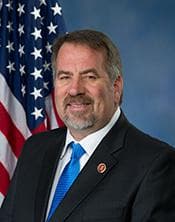
Doug LaMalfa
Republican · Representative for California's 1st district · no longer serving
19 sponsored · 198 cosponsored
Served 2013–2026
Age 66
In the 119th Congress (2025–2026)
- Sponsored 19 bills.The typical House member sponsored 25. Bills they wrote, not ones they signed on to.
- 6 bills they backed became law.They cosponsored them.
- 21 passed the House and wait on the Senate.And 1 has passed both chambers and gone to the President.
- Missed 21 of the 362 recorded votes the House held while they were serving in the 119th Congress (2025–2026), or 5.8%.The typical House member missed 1.9%.
- Works most on health and environmental protection.26 and 18 of the 217 bills they wrote or backed.
What they got done
Most bills never get a vote. These are the ones they wrote or backed that got somewhere.
Became law (6)
This bill updates and extends tax rules related to personal casualty losses from major disasters. It also makes certain wildfire relief payments exempt from gross income.
Became law · 119-HR-5366
- Yes: Does this improve help for people hit by a disaster?The bill provides specific tax relief and income exclusions for individuals affected by major disasters and wildfires. +7
This Act authorizes the award of 3 Congressional Gold Medals to the members of the 1980 U.S. Olympic Men's Ice Hockey Team. The medals recognize the team's victory over the Soviet Union during the 1980 Winter Olympics.
Became law · 119-HR-452
This joint resolution states that Congress disapproves of a specific rule submitted by the Environmental Protection Agency.
Became law · 119-HJRES-89
- Yes: Does this leave more decisions to the states?The resolution supports state-level control by nullifying federal oversight of the EPA rule. +3
- No: Does this better protect air, water and wildlife?Disapproving the EPA rule weakens existing environmental standards for motor vehicle pollution. -4
And 3 more on their Sponsored and Cosponsored pages.
Passed Congress — the President's turn (1)
Both chambers passed it. The President signs it into law or vetoes it, and a veto stands unless two-thirds of each chamber vote to pass it anyway. Everything Congress has sent the President →
This bill directs the government to transfer certain Federal land in California into trust for the Pit River Tribe.
Passed the Senate with no one objecting, no names recorded · 119-HR-2400
- Yes: Would Native Americans be better off under this?The act specifically transfers land into trust for the benefit of the Pit River Tribe. +8
Passed one chamber, waiting on the other (21)
Halfway: the other chamber has to pass the same text before it can go to the President.
This joint resolution is a measure to express congressional disapproval of a specific rule.
Passed the House 216–195 · 119-HJRES-78
- No: Does this better protect air, water and wildlife?The resolution nullifies a rule intended to protect the endangered Longfin Smelt, thereby reducing protections for the species. -5
This bill requires the Secretary of Transportation to issue a rule mandating that new passenger motor vehicles include access to AM broadcast stations as standard equipment.
Passed the House by voice vote, no names recorded · 119-HR-979
- Yes: Does this improve help for people hit by a disaster?The bill enhances the effectiveness of emergency alert systems used during natural disasters. +4
- No: Does this leave more decisions to the states?The bill explicitly prevents states from prescribing laws regarding AM radio access in vehicles. -3
- They cosponsoredNational Law Enforcement Officers Remembrance, Support, and Community Outreach ActSep 14, 2026
This bill is known as the National Law Enforcement Officers Remembrance, Support, and Community Outreach Act.
Passed the House by voice vote, no names recorded · 119-HR-309
- Yes: Would retired people be better off under this?Provides free admission for retired law enforcement officers. +5
And 18 more on their Sponsored and Cosponsored pages.
Still waiting, of the 19 bills they wrote: 17 are in committee. Committee is where most bills end, whoever writes them — silence there, not a vote, is the usual way a bill dies.
What their bills would do
Every bill is scored against plain yes-or-no questions. These count their bills — the ones they wrote and the ones they cosponsored — by how each question was answered: yes, or the opposite. Open one to see those bills, where each stands, and why it was scored that way. Scores are made by AI ().
Who their bills would affect
What else they would change
How they voted lately
Their latest votes that decided something, and what each measure would do.
This bill amends the Social Security Act to stop Federal Medicaid funding for gender transition procedures for people under 18 years old.
The vote on whether to pass the bill — Passed
- No: Would LGBTQ people be better off under this?Directly restricts federally funded medical transition services for minors in the community. -9
119-HR-498 · roll call 362
This Act requires the Secretary of the Interior to reissue a specific final rule regarding the gray wolf.
The vote on whether to pass the bill — Passed
- Yes: Would farmers be better off under this?Removing wolf protections may reduce conflicts and risks to livestock. +5
- No: Does this better protect air, water and wildlife?The bill removes the gray wolf from the endangered species list, reducing federal protections for the species. -7
119-HR-845 · roll call 360
This bill provides for the location of multiple hardrock mining mill sites. It defines mill sites as public land necessary for waste rock disposal or other operations related to mineral development.
The vote on whether to pass the bill — Passed
- Yes: Would business owners be better off under this?The act increases operational efficiency by allowing proprietors to locate multiple mill sites as needed. +5
119-HR-1366 · roll call 358
How busy they have been
How many bills they have put their name to over time — volume, not results: most bills never get a vote.