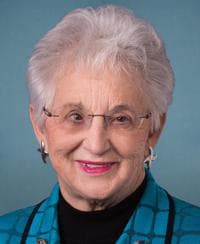
Virginia Foxx
Republican · Representative for North Carolina's 5th district
34 sponsored · 103 cosponsored
In the House since 2005
Age 83
Contact their office: (202) 225-2071 · 2462 Rayburn House Office Building, Washington, DC 20515 · Official website
In the 119th Congress (2025–2026)
- Sponsored 34 bills.The typical House member sponsored 25. Bills they wrote, not ones they signed on to.
- None of the bills they wrote or backed has become law yet.Most bills never get a vote, from any member.
- 10 passed the House and wait on the Senate.And 1 has passed both chambers and gone to the President.
- Missed 3 of 676 recorded votes (0.4%).The typical House member missed 1.9%. The record doesn’t say why.
- Works most on congress and education.20 and 13 of the 137 bills they wrote or backed.
What they got done
Most bills never get a vote. These are the ones they wrote or backed that got somewhere.
Passed Congress — the President's turn (1)
Both chambers passed it. The President signs it into law or vetoes it, and a veto stands unless two-thirds of each chamber vote to pass it anyway. Everything Congress has sent the President →
- They cosponsoredTo authorize the Secretary of the Army to convey to the State of North Carolina a certain parcel of real property located at Fort Bragg, North Carolina, on which the State shall construct a veterans’ State home, and for other purposes.Sep 29, 2026
This bill allows the Secretary of the Army to give a specific piece of land at Fort Bragg in North Carolina to the State of North Carolina without charging them for it.
Passed the Senate with no one objecting, no names recorded · 119-HR-10159
- Yes: Would veterans be better off under this, taking everything together?Directly enables the construction of a state home specifically for veterans' use. +9
Passed one chamber, waiting on the other (10)
Halfway: the other chamber has to pass the same text before it can go to the President.
This bill seeks to amend the Higher Education Act of 1965.
Passed the House 237–169 · 119-HR-4795
- Yes: Would students be better off under this?Ensures access to academic programs and study abroad opportunities in strategic partner countries. +5
- No: Does this protect what people are allowed to say in public life?Could be interpreted as limiting the expressive freedom of institutions to engage in boycotts. -3
This bill amends the Elementary and Secondary Education Act of 1965. The legislation excludes the three-cueing model from comprehensive literacy instruction.
Passed the House by voice vote, no names recorded · 119-HR-7890
- Yes: Would students be better off under this?The bill promotes instructional methods designed to improve fundamental reading skills. +6
This bill requires the Secretary of Transportation to issue a rule mandating that new passenger motor vehicles include access to AM broadcast stations as standard equipment.
Passed the House by voice vote, no names recorded · 119-HR-979
- Yes: Does this improve help for people hit by a disaster?The bill enhances the effectiveness of emergency alert systems used during natural disasters. +4
- No: Does this leave more decisions to the states?The bill explicitly prevents states from prescribing laws regarding AM radio access in vehicles. -3
And 7 more on their Sponsored and Cosponsored pages.
Resolutions of theirs that were adopted (15)
A resolution is a chamber speaking for itself — a position, a rule or a tribute. Adopting it puts it into effect, but it is not a law.
- Providing for consideration of the bill (H.R. 1501) to amend the FAST Act to include certain mineral production activities as a covered project, and for other purposes; providing for consideration of the bill (H.R. 9436) to amend the Consolidated Appropriations Act, 2023 to extend the time period for which certain regulations concerning the North Atlantic right whale are effective; providing for consideration of the resolution (H. Res. 1490) providing for the condemnation and denouncement of socialism in all its forms, and for other purposes; providing for consideration of the bill (H.R. 4795) to amend the Higher Education Act of 1965 to prohibit an institution that participates in a nonexpressive commercial boycott of Israel from being eligible for certain funds under that Act, to require an institution that participates in certain programs under that Act to certify that students are not unreasonably obstructed from participating in academic programs in Israel, and for other purposes; and relating to consideration of motions to suspend the rules.
- Providing for consideration of the bill (H.R. 8800) to authorize appropriations for fiscal year 2027 for military activities of the Department of Defense, for military construction, and for defense activities of the Department of Energy, to prescribe military personnel strengths for such fiscal year, and for other purposes; providing for consideration of the bill (H.R. 8884) to amend title II of the Social Security Act to reauthorize demonstration authority for the disability insurance program; providing for consideration of the concurrent resolution (H. Con. Res. 113) establishing the congressional budget for the United States Government for fiscal year 2027 and setting forth the appropriate budgetary levels for fiscal years 2028 through 2036; providing for consideration of the bill (H.R. 7008) to amend chapter 131 of title 5 to require certain restrictions on stocks for Members of Congress and their spouses and dependents, and for other purposes; providing for consideration of the bill (H.R. 6955) to make improvements to the Federal banking laws, and for other purposes; providing for consideration of the bill (H.R. 9770) making continuing appropriations for fiscal year 2027, and for other purposes; and for other purposes.
- Providing for consideration of the bill (H.R. 139) to make daylight savings time permanent, and for other purposes; providing for consideration of the bill (H.R. 8595) making appropriations for national security, Department of State, and related programs for the fiscal year ending September 30, 2027, and for other purposes; providing for consideration of the bill (H.R. 9237) to amend titles 10 and 38, United States Code, and other Federal laws, to improve benefits for veterans and the administration of the Department of Veterans Affairs; providing for consideration of the bill (H.R. 1181) to prohibit payment card networks and covered entities from requiring the use of or assigning merchant category codes that distinguish a firearms retailer from general-merchandise retailer or sporting-goods retailer, and for other purposes; and for other purposes.
- Waiving a requirement of clause 6(a) of rule XIII with respect to consideration of certain resolutions reported from the Committee on Rules.
- Providing for consideration of the bill (H.R. 556) to prohibit the Secretary of the Interior and the Secretary of Agriculture from prohibiting the use of lead ammunition or tackle on certain Federal land or water under the jurisdiction of the Secretary of the Interior and the Secretary of Agriculture, and for other purposes; providing for consideration of the bill (H.R. 1958) to amend the Immigration and Nationality Act to clarify that aliens who have been convicted of defrauding the United States Government or the unlawful receipt of public benefits are inadmissible and deportable; providing for consideration of the bill (H.R. 4638) to amend the Immigration and Nationality Act to provide that an alien who has been convicted of harming animals used in law enforcement is inadmissible and deportable, and for other purposes; and relating to consideration of motions to suspend the rules.
- Providing for consideration of the bill (H.R. 7148) making further consolidated appropriations for the fiscal year ending September 30, 2026, and for other purposes; providing for consideration of the bill (H.R. 7147) making further consolidated appropriations for the fiscal year ending September 30, 2026, and for other purposes; and for other purposes.
- Providing for consideration of the bill (H.R. 7006) making further consolidated appropriations for the fiscal year ending September 30, 2026, and for other purposes.
- Electing a member to a certain standing committee of the House of Representatives.
- Providing for consideration of the joint resolution (S.J. Res. 80) providing for congressional disapproval under chapter 8 of title 5, United States Code, of the rule submitted by the Bureau of Land Management relating to National Petroleum Reserve in Alaska Integrated Activity Plan Record of Decision; providing for consideration of the joint resolution (H.J. Res. 130) providing for congressional disapproval under chapter 8 of title 5, United States Code, of the rule submitted by the Bureau of Land Management relating to Buffalo Field Office Record of Decision and Approved Resource Management Plan Amendment; providing for consideration of the joint resolution (H.J. Res. 131) providing for congressional disapproval under chapter 8 of title 5, United States Code, of the rule submitted by the Bureau of Land Management relating to Coastal Plain Oil and Gas Leasing Program Record of Decision; providing for consideration of the concurrent resolution (H. Con. Res. 58) denouncing the horrors of socialism; providing for consideration of the bill (H.R. 1949) to repeal restrictions on the export and import of natural gas; providing for consideration of the bill (H.R. 3109) to require the Secretary of Energy to direct the National Petroleum Council to issue a report with respect to petrochemical refineries in the United States, and for other purposes; providing for consideration of the bill (H.R. 5107) to repeal the Comprehensive Policing and Justice Reform Amendment Act of 2022 enacted by the District of Columbia Council; providing for consideration of the bill (H.R. 5214) to require mandatory pretrial and post conviction detention for crimes of violence and dangerous crimes and require mandatory cash bail for certain offenses that pose a threat to public safety or order in the District of Columbia, and for other purposes; and for other purposes.
- Relating to consideration of the Senate amendment to the bill (H.R. 4) to rescind certain budget authority proposed to be rescinded in special messages transmitted to the Congress by the President on June 3, 2025, in accordance with section 1012(a) of the Congressional Budget and Impoundment Control Act of 1974.
- Providing for consideration of the Senate amendment to the bill (H.R. 1) to provide for reconciliation pursuant to title II of H. Con. Res. 14.
- Providing for consideration of the bill (H.R. 4) to rescind certain budget authority proposed to be rescinded in special messages transmitted to the Congress by the President on June 3, 2025, in accordance with section 1012(a) of the Congressional Budget and Impoundment Control Act of 1974, and for other purposes.
- Providing for consideration of the Senate amendment to the concurrent resolution (H. Con. Res. 14) establishing the congressional budget for the United States Government for fiscal year 2025 and setting forth the appropriate budgetary levels for fiscal years 2026 through 2034, and for other purposes.
- Providing for consideration of the joint resolution (S.J. Res. 18) disapproving the rule submitted by the Bureau of Consumer Financial Protection relating to "Overdraft Lending: Very Large Financial Institutions"; providing for consideration of the joint resolution (S.J. Res. 28) disapproving the rule submitted by the Bureau of Consumer Financial Protection relating to "Defining Larger Participants of a Market for General-Use Digital Consumer Payment Applications"; providing for consideration of the bill (H.R. 1526) to amend title 28, United States Code, to limit the authority of district courts to provide injunctive relief, and for other purposes; providing for consideration of the bill (H.R. 22) to amend the National Voter Registration Act of 1993 to require proof of United States citizenship to register an individual to vote in elections for Federal office, and for other purposes; and for other purposes.
- Providing for consideration of the joint resolution (H.J. Res. 24) providing for congressional disapproval under chapter 8 of title 5, United States Code, of the rule submitted by the Department of Energy relating to "Energy Conservation Program: Energy Conservation Standards for Walk-In Coolers and Walk-In Freezers"; providing for consideration of the joint resolution (H.J. Res. 75) providing for congressional disapproval under chapter 8 of title 5, United States Code, of the rule submitted by the Office of Energy Efficiency and Renewable Energy, Department of Energy relating to "Energy Conservation Program: Energy Conservation Standards for Commercial Refrigerators, Freezers, and Refrigerator-Freezers"; and providing for consideration of the bill (H.R. 1048) to amend the Higher Education Act of 1965 to strengthen disclosure requirements relating to foreign gifts and contracts, to prohibit contracts between institutions of higher education and certain foreign entities and countries of concern, and for other purposes.
Still waiting, of the 34 bills they wrote: 3 cleared committee and wait for a first vote, 15 are in committee. Committee is where most bills end, whoever writes them — silence there, not a vote, is the usual way a bill dies.
What their bills would do
Every bill is scored against plain yes-or-no questions. These count their bills — the ones they wrote and the ones they cosponsored — by how each question was answered: yes, or the opposite. Open one to see those bills, where each stands, and why it was scored that way. Scores are made by AI ().
Who their bills would affect
What else they would change
How they voted lately
Their latest votes that decided something, and what each measure would do.
This bill amends the Employee Retirement Income Security Act of 1974. The main purpose is to provide a clear definition of adequate consideration for certain closely held stock.
A fast-track vote, needing two-thirds to pass — Passed
- Yes: Would retired people be better off under this?Improving the clarity of stock valuation for ESOPs supports more stable retirement transitions. +4
119-S-2403 · roll call 314
This Act provides for improvements to rivers and harbors in the United States and the conservation and development of water and related resources.
A fast-track vote, needing two-thirds to pass — Passed
- Yes: Would Native Americans be better off under this?Directly authorizes land transfers to Tribal entities and prioritizes technical assistance for Tribal communities. +8
- No: Does this reduce what the federal government spends?The bill explicitly increases spending limits and funding authorizations for dozens of regional water resource programs. -5
119-HR-9497 · roll call 313
This bill amends the Public Utility Regulatory Policies Act of 1978 to create a new Federal standard regarding the costs of upgrades for large-load customers.
A fast-track vote, needing two-thirds to pass — Passed
- Yes: Does this keep data centers from raising household electric and water bills?The bill requires large-load customers to cover the full incremental cost of grid upgrades and provide financial assurances, preventing those costs from being passed to households. +7
- No: Would business owners be better off under this?Large-scale non-residential energy consumers face increased costs and financial assurance requirements. -5
119-HR-9340 · roll call 312
On the President’s vetoes
The President can refuse to sign a bill both chambers passed. It becomes law anyway only if two-thirds of the House and two-thirds of the Senate vote to pass it again. A vote against the veto (a Yea) was a vote to make the bill law over the President’s objection; a vote for it (a Nay) was a vote to let the veto stand.
Finish the Arkansas Valley Conduit Act — vetoed Dec 29, 2025
For the vetovoted Nay, to let the veto stand.
The override fell short in the House, 248–177; it needed two-thirds · Jan 8, 2026
Miccosukee Reserved Area Amendments Act — vetoed Dec 29, 2025
For the vetovoted Nay, to let the veto stand.
The override fell short in the House, 236–188; it needed two-thirds · Jan 8, 2026
How busy they have been
How many bills they have put their name to over time — volume, not results: most bills never get a vote.