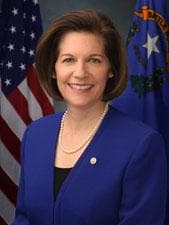

Catherine Cortez Masto

Catherine Cortez Masto

Democrat · U.S. Senator for Nevada

125 sponsored · 424 cosponsored

Age 62 · In office since 2017

Contact their office: (202) 224-3542 · 309 Hart Senate Office Building, Washington, DC 20510 · Official website

What they got done

Most bills never get a vote. These are the ones they wrote or backed that got somewhere.

Became law (4)

  • Mike Crapo (R-ID)

    Cosponsored

    Secure Rural Schools Reauthorization Act of 2025

    S. 356 Public Lands and Natural Resources

    A Republican bill with 16 Democratic cosponsors. See the voting map.

    Became law

    The House voted 399–5 on Dec 9.

    This bill aims to extend the Secure Rural Schools and Community Self-Determination Act of 2000. It extends various deadlines and years within the original act, such as changing certain dates from 2023 to 2026.

    Yes· 2 of 7

    • Scored +5

      Would people in rural areas be better off under this?

      The bill directly extends financial payments and project authority to rural counties containing federal land.

    • Scored +5

      Does this invest in rural communities?

      The bill explicitly extends funding and authority for counties with federal lands to support their local development and special projects.

    No question was scored the opposite.

  • Jerry Moran (R-KS)

    Cosponsored

    Veterans’ Compensation Cost-of-Living Adjustment Act of 2025

    S. 2392 Armed Forces and National Security

    A Republican bill with 14 Democratic cosponsors.

    Became law

    This Act aims to increase compensation rates for various groups.

    Yes· 2 of 6

    • Scored +7

      Would veterans be better off under this, taking everything together?

      The bill directly increases rates for wartime disability compensation and clothing allowances for veterans.

    • Scored +7

      Does this increase the pay, pensions or support veterans receive?

      The bill mandates an increase in disability compensation, clothing allowances, and dependency compensation for veterans and their families.

    No question was scored the opposite.

  • Bill Cassidy (R-LA)

    Cosponsored

    HALT Fentanyl Act

    S. 331 Crime and Law Enforcement

    A Republican bill with 6 Democratic cosponsors. See the voting map.

    Became law

    The House voted 321–104 on Jun 12.

    This bill permanently places all fentanyl-related substances into schedule I of the Controlled Substances Act.

    Yes· 2 of 9

    • Scored +6

      Does this do more about addiction and overdose deaths?

      The act directly attempts to combat the fentanyl crisis by increasing penalties and attempting to decrease availablity.

    • Scored +3

      Does this put more money into scientific research?

      Streamlining research registration may indirectly incentivize funding for scientific research related to fentanyl and other schedule I substances.

    The opposite· 2 of 10

    • Scored -3

      Does this shorten or soften prison sentences?

      Increased penalties for fentanyl-related substances could lead to longer prison sentences, hindering criminal sentencing reform efforts.

    • Scored -2

      Would households on low incomes be better off under this?

      Increased penalties could disproportionately affect low-income households due to the higher likelihood of being involved in the criminal justice system.

And 1 more on their Sponsored and Cosponsored pages.

Passed one chamber, waiting on the other (19)

Halfway: the other chamber has to pass the same text before it can go to the President.

  • Catherine Cortez Masto (D-NV)

    Their bill

    Veterans Protection from Fraud Act of 2026

    S. 4445 Crime and Law Enforcement

    A Democratic bill with 1 Republican cosponsor.

    Passed the Senate

    By voice vote, no names recorded

    Now: kept ready for the floor instead of being sent to a committee · Nov 20

    This bill changes federal law to increase penalties for certain crimes. Specifically, it targets offenses committed against veterans. The bill was passed by the Senate on November 18, 2026.

    Yes· 2 of 4

    • Scored +6

      Would veterans be better off under this, taking everything together?

      The bill enhances protections for veterans by increasing penalties for crimes committed against them.

    • Scored +5

      Does this shorten or soften prison sentences?

      The bill increases penalties for crimes committed against targeted veterans of any age.

    No question was scored the opposite.

  • Catherine Cortez Masto (D-NV)

    Their bill

    Tribal Access to Electronic Evidence Act

    S. 1574 Native Americans

    A Democratic bill with 3 Republican cosponsors.

    Passed the Senate

    With no one objecting, no names recorded

    Now: kept ready for the floor instead of being sent to a committee · Oct 5

    This bill amends the Stored Communications Act to include Tribal courts as courts of competent jurisdiction.

    Yes· 2 of 5

    • Scored +8

      Would Native Americans be better off under this?

      Significantly empowers Tribal courts and governments by granting them the authority to access electronic evidence.

    • Scored +3

      Would people in rural areas be better off under this?

      Positive impact for those living in Tribal jurisdictions who benefit from enhanced local law enforcement capabilities.

    The opposite

    • Scored -3

      Does this give people more control over their personal data?

      Allows for the disclosure of stored electronic communications and records by Tribal authorities, potentially reducing privacy.

    • Scored -3

      Does this protect people from being watched or searched?

      Enables Tribal authorities to access electronic records and potentially delay notification to the individual.

  • Catherine Cortez Masto (D-NV)

    Their bill

    Tribal Warrant Fairness Act

    S. 3041 Native Americans

    A Democratic bill with 6 Republican cosponsors.

    Passed the Senate

    By voice vote, no names recorded

    Now: kept ready for the floor instead of being sent to a committee · Jun 15

    This bill allows the U.S. Marshals Service to help with certain Tribal criminal matters. Specifically, the U.S. Marshals Service can assist with Tribal fugitive matters when an Indian Tribe asks them to.

    Yes· 2 of 4

    • Scored +7

      Would Native Americans be better off under this?

      The bill directly benefits Native Americans and indigenous communities by providing federal U.S. Marshals Service support for tribal criminal and fugitive matters upon request.

    • Scored +6

      Does this narrow racial gaps in how people are treated?

      The bill enhances tribal sovereignty and law enforcement cooperation by authorizing the U.S. Marshals Service to assist with tribal criminal and fugitive matters.

    No question was scored the opposite.

And 16 more on their Sponsored and Cosponsored pages.

Resolutions of theirs that were adopted (8)

A resolution is a chamber speaking for itself — a position, a rule or a tribute. Adopting it puts it into effect, but it is not a law.

Still waiting, of the 125 bills they wrote: 6 cleared committee and wait for a first vote, 104 are in committee. Committee is where most bills end, whoever writes them — silence there, not a vote, is the usual way a bill dies.

What their bills would do

Every bill is scored against plain yes-or-no questions. These count their bills — the ones they wrote and the ones they cosponsored — by how each question was answered: yes, or the opposite. Open one to see those bills, where each stands, and why it was scored that way. Scores are made by AI ().

Who their bills would affect

What else they would change

How they voted lately

Their latest votes that decided something, and what each measure would do.

  • U.S. Senate · Nov 20, 2026

    Bipartisan American Affordability and Jobs Act of 2026

    The vote on whether to pass the bill This is the real decision in this chamber. Passing here sends the bill to the other chamber, which must pass it too before it can go to the President.

    Their vote Nay

    This bill aims to accelerate energy projects and infrastructure development by reforming federal environmental reviews, permitting procedures, and court review rules.

    • Scored +5

      Would women be better off under this?

      By protecting settlement money from taxation, the bill provides greater financial security for women survivors of sexual violence.

  • U.S. Senate · Nov 19, 2026

    Directing the President, pursuant to section 5(c) of the War Powers Resolution, to remove United States Armed Forces from hostilities with Iran.

    The vote on whether to adopt the resolution A resolution is one chamber speaking for itself — setting its own rules, taking a position, honouring someone — and it never goes to the President. Agreeing to it is the whole decision.

    Their vote Yea

    This resolution directs the President to remove United States Armed Forces from hostilities with Iran. It uses the authority found under section 5(c) of the War Powers Resolution.

    • Scored +4

      Does this favour talking over confrontation abroad?

      Ending hostilities can pave the way for diplomatic resolutions between the US and Iran.

    • Scored -5

      Does this give the federal government more power?

      The bill limits the Executive branch's power to engage in military hostilities without Congressional approval.

  • U.S. Senate · Nov 18, 2026

    In the nature of a substitute.

    A vote on a proposed change to the bill A vote on one change, not on the bill. A bill can collect dozens of these, and losing one does not stop it.

    Their vote Nay

    This amendment amends the Internal Revenue Code of 1986 to exclude from gross income any damages, other than punitive damages, received on account of sexual acts or sexual contact.

Every vote they cast, and how often they missed one →

On the President’s nominees

The President chooses federal judges, cabinet secretaries, ambassadors and military officers, and the Senate decides whether each one gets the job. Most are confirmed by voice vote, which records no one’s position. In the 119th Congress (2025–2026) the Senate put 228 confirmations to a recorded vote, and confirmed every one.

Their votes to confirm, of 228 recorded votes

  • Yes: 20
  • No: 204
  • Missed: 4

Those votes covered 594 nominees, because the Senate sometimes confirms many in a single vote.

The 5 most recent they voted against

How busy they have been

How many bills they have put their name to over time — volume, not results: most bills never get a vote.

Legislative activity over time