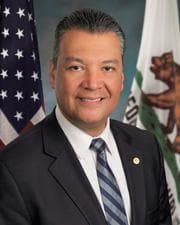


Alex Padilla

Alex Padilla

Democrat · U.S. Senator for California

118 sponsored · 720 cosponsored

Age 53 · In office since 2021

Contact their office: (202) 224-3553 · 331 Hart Senate Office Building, Washington, DC 20510 · Official website

What they got done

Most bills never get a vote. These are the ones they wrote or backed that got somewhere.

Became law (5)

  • Ted Cruz (R-TX)

    Cosponsored

    LACA

    S. 32 Law

    A Republican bill with 1 Democratic cosponsor. See the voting map.

    Became law

    The House voted 378–10 on Aug 31.

    Its main job is to clarify where court may be held for certain district courts in the states of Texas and California. Specifically, it updates the organization of Texas district courts and California district courts.

    Yes· 2 of 5

    • Scored +3

      Would people in rural areas be better off under this?

      Adding locations like El Centro and College Station increases judicial access for regional and rural residents.

    • Scored +2

      Does this protect the right to fair treatment by the courts?

      Increasing the number of locations where court may be held can improve accessibility to legal proceedings.

    No question was scored the opposite.

  • Mitch McConnell (R-KY)

    Cosponsored

    A bill to amend chapters 83 and 84 of title 5, United States Code, to authorize an increase of the retirement age for members of the Capitol Police.

    S. 4530 Government Operations and Politics

    A Republican bill with 1 Democratic cosponsor.

    Became law

    This bill aims to amend chapters 83 and 84 of title 5 of the United States Code. The primary purpose is to authorize an increase in the retirement age for members of the Capitol Police.

    The opposite· 2 of 3

    • Scored -3

      Would people over 65 be better off under this?

      The bill allows for a retirement age of up to 62, which could force older employees to remain in the workforce longer than the previous fixed age of 60.

    • Scored -3

      Would retired people be better off under this?

      The shift from a fixed retirement age of 60 to a Board-determined age as high as 62 may delay the ability of officers to retire.

    No question was scored yes.

  • Thomas Tillis (R-NC)

    Cosponsored

    Semiquincentennial Congressional Time Capsule Act

    S. 3705 Congress

    A Republican bill with 2 Democratic cosponsors.

    Became law

    This Act establishes the "Semiquincentennial Congressional Time Capsule" to commemorate the United States semiquincentennial.

    Yes· 2 of 7

    • Scored +1

      Would children be better off under this?

      The act preserves a historical record that will be available to future generations including children.

    • Scored +1

      Would people in middle age be better off under this?

      The act preserves a historical record that will be available to future generations including middle-aged adults.

    No question was scored the opposite.

And 2 more on their Sponsored and Cosponsored pages.

Passed Congress — the President's turn (1)

Both chambers passed it. The President signs it into law or vetoes it, and a veto stands unless two-thirds of each chamber vote to pass it anyway. Everything Congress has sent the President →

Passed one chamber, waiting on the other (27)

Halfway: the other chamber has to pass the same text before it can go to the President.

  • Alex Padilla (D-CA)

    Their bill

    Scarper Ridge Golden Gate National Recreation Area Boundary Adjustment Act

    S. 1142 Public Lands and Natural Resources

    A Democratic bill with 1 Democratic cosponsor.

    Passed the Senate

    With no one objecting, no names recorded

    Now: kept ready for the floor instead of being sent to a committee · Mar 27

    This Act aims to change the boundaries of the Golden Gate National Recreation Area. The purpose of the bill is to include the Scarper Ridge property within the recreation area.

    Yes· 2 of 3

    • Scored +5

      Does this better protect public land such as parks and forests?

      Incorporating more land into a national recreation area improves federal management of public land.

    • Scored +3

      Does this better protect air, water and wildlife?

      The expansion of the national recreation area likely enhances local land and environmental conservation.

    No question was scored the opposite.

  • Alex Padilla (D-CA)

    Their bill

    National Earthquake Hazards Reduction Program Reauthorization Act of 2025

    S. 320 Emergency Management

    A Democratic bill with 1 Republican cosponsor.

    Passed the Senate

    With no one objecting, no names recorded

    Now: kept ready for the floor instead of being sent to a committee · Jan 7

    This Act reauthorizes the Earthquake Hazards Reduction Act of 1977. It updates findings to include updated economic exposure and loss estimates for earthquake damage.

    Yes· 2 of 12

    • Scored +5

      Would Native Americans be better off under this?

      The bill expands the scope of the program to specifically include Tribal governments and jurisdictions.

    • Scored +5

      Does this put more money into scientific research?

      The bill provides updated annual authorizations for scientific research through the USGS and NSF.

    No question was scored the opposite.

  • Alex Padilla (D-CA)

    Their bill

    A bill to reaffirm the applicability of the Indian Reorganization Act to the Lytton Rancheria of California, and for other purposes.

    S. 748 Native Americans

    A Democratic bill with no cosponsors.

    Passed the Senate

    With no one objecting, no names recorded

    Now: kept ready for the floor instead of being sent to a committee · Dec 16

    This act aims to reaffirm that the Indian Reorganization Act applies to the Lytton Rancheria of California.

    Yes· 2 of 4

    • Scored +7

      Would Native Americans be better off under this?

      The bill explicitly enables the Lytton Rancheria of California to expand its reservation and land held in trust.

    • Scored +5

      Does this narrow racial gaps in how people are treated?

      The bill strengthens tribal sovereignty and land base for the Lytton Rancheria of California.

    The opposite

    • Scored -2

      Does this leave more decisions to the states?

      The bill expands federal authority to take land into trust for the tribe, which can overlap with state jurisdictions.

    • Scored -1

      Would people in cities be better off under this?

      Land being moved into federal trust status can impact local land use and development in the surrounding area.

And 24 more on their Sponsored and Cosponsored pages.

Resolutions of theirs that were adopted (7)

A resolution is a chamber speaking for itself — a position, a rule or a tribute. Adopting it puts it into effect, but it is not a law.

Still waiting, of the 118 bills they wrote: 9 cleared committee and wait for a first vote, 98 are in committee. Committee is where most bills end, whoever writes them — silence there, not a vote, is the usual way a bill dies.

What their bills would do

Every bill is scored against plain yes-or-no questions. These count their bills — the ones they wrote and the ones they cosponsored — by how each question was answered: yes, or the opposite. Open one to see those bills, where each stands, and why it was scored that way. Scores are made by AI ().

Who their bills would affect

What else they would change

How they voted lately

Their latest votes that decided something, and what each measure would do.

  • U.S. Senate · Nov 20, 2026

    Bipartisan American Affordability and Jobs Act of 2026

    The vote on whether to pass the bill This is the real decision in this chamber. Passing here sends the bill to the other chamber, which must pass it too before it can go to the President.

    Their vote Nay

    This bill aims to accelerate energy projects and infrastructure development by reforming federal environmental reviews, permitting procedures, and court review rules.

    • Scored +5

      Would women be better off under this?

      By protecting settlement money from taxation, the bill provides greater financial security for women survivors of sexual violence.

  • U.S. Senate · Nov 19, 2026

    Directing the President, pursuant to section 5(c) of the War Powers Resolution, to remove United States Armed Forces from hostilities with Iran.

    The vote on whether to adopt the resolution A resolution is one chamber speaking for itself — setting its own rules, taking a position, honouring someone — and it never goes to the President. Agreeing to it is the whole decision.

    Their vote Yea

    This resolution directs the President to remove United States Armed Forces from hostilities with Iran. It uses the authority found under section 5(c) of the War Powers Resolution.

    • Scored +4

      Does this favour talking over confrontation abroad?

      Ending hostilities can pave the way for diplomatic resolutions between the US and Iran.

    • Scored -5

      Does this give the federal government more power?

      The bill limits the Executive branch's power to engage in military hostilities without Congressional approval.

  • U.S. Senate · Nov 18, 2026

    In the nature of a substitute.

    A vote on a proposed change to the bill A vote on one change, not on the bill. A bill can collect dozens of these, and losing one does not stop it.

    Their vote Nay

    This amendment amends the Internal Revenue Code of 1986 to exclude from gross income any damages, other than punitive damages, received on account of sexual acts or sexual contact.

Every vote they cast, and how often they missed one →

On the President’s nominees

The President chooses federal judges, cabinet secretaries, ambassadors and military officers, and the Senate decides whether each one gets the job. Most are confirmed by voice vote, which records no one’s position. In the 119th Congress (2025–2026) the Senate put 228 confirmations to a recorded vote, and confirmed every one.

Their votes to confirm, of 228 recorded votes

  • Yes: 7
  • No: 212
  • Missed: 9

Those votes covered 589 nominees, because the Senate sometimes confirms many in a single vote.

The 5 most recent they voted against

How busy they have been

How many bills they have put their name to over time — volume, not results: most bills never get a vote.

Legislative activity over time