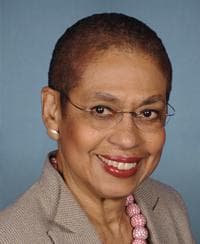

Eleanor Holmes Norton

Eleanor Holmes Norton

Democrat · U.S. Delegate for District of Columbia

114 sponsored · 2058 cosponsored

Age 89 · In office since 1991

Contact their office: (202) 225-8050 · 2136 Rayburn House Office Building, Washington, DC 20510 · Official website

What they got done

Most bills never get a vote. These are the ones they wrote or backed that got somewhere.

Became law (5)

  • John Joyce (R-PA)

    Cosponsored

    Choices for Increased Mobility Act of 2026

    H.R. 1703 Health

    A Republican bill with 4 Democratic cosponsors.

    Became law

    This bill amends title XVIII of the Social Security Act to clear up payment rules for manual wheelchairs under Medicare Part B.

    Yes· 2 of 6

    • Scored +3

      Does this expand the rights of people with disabilities?

      The bill addresses specific needs for ultralightweight manual wheelchairs which are essential for mobility and independence.

    • Scored +2

      Would people over 65 be better off under this?

      The bill clarifies Medicare coverage rules for specialized wheelchairs which benefits older adults relying on Medicare Part B.

    The opposite

    • Scored -3

      Would households on low incomes be better off under this?

      The bill allows suppliers to charge individuals the difference between the Medicare payment and the actual cost, which could create financial burdens.

    • Scored -2

      Does this lower what people pay out of pocket for care, such as deductibles, copays and surprise bills?

      The bill allows suppliers to charge individuals the difference between the actual charge and the Medicare payment amount.

  • Mike Quigley (D-IL)

    Cosponsored

    Accelerating Access to Critical Therapies for ALS Reauthorization Act of 2026

    H.R. 8205 Health

    A Democratic bill with 39 Republican cosponsors.

    Became law

    This bill extends the provisions and grants for ALS research found in the original Act through fiscal year 2031.

    Yes· 2 of 3

    • Scored +7

      Does this put more money into medical research?

      The bill extends the authorization of grants for ALS research through fiscal year 2031.

    • Scored +6

      Would people with disabilities be better off under this?

      The bill promotes research into therapies for ALS, a debilitating neurodegenerative disease.

    No question was scored the opposite.

And 2 more on their Sponsored and Cosponsored pages.

Passed Congress — the President's turn (2)

Both chambers passed it. The President signs it into law or vetoes it, and a veto stands unless two-thirds of each chamber vote to pass it anyway. Everything Congress has sent the President →

  • Kat Cammack (R-FL)

    Cosponsored

    Charlotte Woodward Organ Transplant Discrimination Prevention Act

    H.R. 1520 Health

    A Republican bill with 13 Democratic cosponsors.

    Passed both chambers

    With no one objecting, no names recorded

    This bill stops discrimination against qualified individuals with disabilities when it comes to organ transplants and related services.

    Yes· 2 of 5

    • Scored +10

      Would people with disabilities be better off under this?

      The bill prevents healthcare entities from denying organ transplants solely based on an individual's disability.

    • Scored +10

      Does this expand the rights of people with disabilities?

      The bill prohibits discrimination in organ transplant access and requires reasonable modifications to policies for qualified individuals.

    No question was scored the opposite.

  • Ritchie Torres (D-NY)

    Cosponsored

    Setting Consumer Standards for Lithium-Ion Batteries Act

    H.R. 973 Commerce

    A Democratic bill with 6 Republican cosponsors. See the voting map.

    Passed both chambers

    The House voted 365–42 on Apr 28.

    With no one objecting, no names recorded

    This bill requires the Consumer Product Safety Commission to set safety standards for certain batteries used in light electric vehicles, eBikes, and personal e-mobility devices.

    Yes· 2 of 4

    • Scored +7

      Does this give people more protection from unfair business practices?

      The bill mandates safety standards for lithium-ion batteries used in eBikes and other personal mobility devices to protect consumers.

    • Scored +5

      Does this make what the government does easier for the public to see?

      The bill requires the Commission to submit a detailed report to Congress regarding battery-related hazards and manufacturer information.

    No question was scored the opposite.

Passed one chamber, waiting on the other (31)

Halfway: the other chamber has to pass the same text before it can go to the President.

  • Eleanor Norton (D-DC)

    Their bill

    Securities and Exchange Commission Real Estate Leasing Authority Revocation Act

    H.R. 189 Government Operations and Politics

    A Democratic bill with no cosponsors.

    Passed the House

    By voice vote, no names recorded

    Now: handed to a committee to examine — Committee on Banking, Housing, and Urban Affairs · Jan 14

    This Act aims to change how the SEC handles office space. It amends title 40 of the United States Code to stop the Securities and Exchange Commission from leasing general purpose office space.

    Yes· 2 of 3

    • Scored +3

      Does this make the government pay for what it commits to?

      The bill mandates a GAO review of independent leasing authorities to ensure more controlled and transparent use of federal funds.

    • Scored +3

      Does this make what the government does easier for the public to see?

      The bill requires a Comptroller General review to track how federal entities utilize independent leasing authorities and how they utilize the GSA.

    No question was scored the opposite.

  • Jefferson Shreve (R-IN)

    Cosponsored

    Dismantle Foreign Scam Syndicates Act

    H.R. 5490 International Affairs

    A Republican bill with 30 Democratic cosponsors.

    Passed the House

    By voice vote, no names recorded

    Now: handed to a committee to examine — Committee on Foreign Relations · Nov 19

    This bill sets up an interagency task force led by the Secretary of State to shut down international online scam operations, such as pig butchering scams.

    Yes· 2 of 17

    • Scored +7

      Would immigrants be better off under this?

      Provides support and reintegration services for trafficking victims forced into scam centers.

    • Scored +7

      Does this give people more protection from unfair business practices?

      The bill aims to protect U.S. citizens from mass online financial scams and recover stolen assets.

    The opposite

    • Scored -2

      Does this protect the right to fair treatment by the courts?

      The broad authority for sanctions based on 'credible evidence' could potentially lead to misidentification.

  • Gus Bilirakis (R-FL)

    Cosponsored

    Major Richard Star Act

    H.R. 2102 Armed Forces and National Security

    A Republican bill with 207 Democratic cosponsors. See the voting map.

    Passed the House

    39218

    Now: handed to a committee to examine — Committee on Armed Services · Nov 12

    This bill aims to change the rules regarding how certain military retirees receive their pay. Specifically, it focuses on disability retirees who have combat-related disabilities.

    Yes· 2 of 3

    • Scored +8

      Would veterans be better off under this, taking everything together?

      This bill provides significant financial relief to veterans with combat-related disabilities by allowing them to receive both retired pay and disability compensation concurrently.

    • Scored +7

      Does this increase the pay, pensions or support veterans receive?

      The bill increases financial benefits for veterans with combat-related disabilities by allowing concurrent receipt of retired pay and disability compensation.

    No question was scored the opposite.

And 28 more on their Sponsored and Cosponsored pages.

Still waiting, of the 114 bills they wrote: 113 are in committee. Committee is where most bills end, whoever writes them — silence there, not a vote, is the usual way a bill dies.

What their bills would do

Every bill is scored against plain yes-or-no questions. These count their bills — the ones they wrote and the ones they cosponsored — by how each question was answered: yes, or the opposite. Open one to see those bills, where each stands, and why it was scored that way. Scores are made by AI ().

Who their bills would affect

What else they would change

How they voted lately

Their latest votes that decided something, and what each measure would do.

Every vote they cast, and how often they missed one →

How busy they have been

How many bills they have put their name to over time — volume, not results: most bills never get a vote.

Legislative activity over time