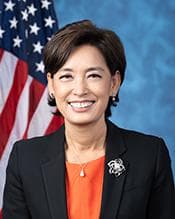


Young Kim

Young Kim

Republican · U.S. Representative for California's 40th district

59 sponsored · 383 cosponsored

Age 64 · In office since 2021

Contact their office: (202) 225-4111 · 2439 Rayburn House Office Building, Washington, DC 20515 · Official website

What they got done

Most bills never get a vote. These are the ones they wrote or backed that got somewhere.

Became law (3)

  • Mike Quigley (D-IL)

    Cosponsored

    Accelerating Access to Critical Therapies for ALS Reauthorization Act of 2026

    H.R. 8205 Health

    A Democratic bill with 39 Republican cosponsors.

    Became law

    This bill extends the provisions and grants for ALS research found in the original Act through fiscal year 2031.

    Yes· 2 of 3

    • Scored +7

      Does this put more money into medical research?

      The bill extends the authorization of grants for ALS research through fiscal year 2031.

    • Scored +6

      Would people with disabilities be better off under this?

      The bill promotes research into therapies for ALS, a debilitating neurodegenerative disease.

    No question was scored the opposite.

  • J. Hill (R-AR)

    Cosponsored

    21st Century ROAD to Housing Act

    H.R. 6644 Housing and Community Development

    A Republican bill with 16 Democratic cosponsors. See the voting map.

    Became law

    The House voted 358–32 on Jun 23.

    The 21st Century ROAD to Housing Act aims to increase housing supply and affordability across the United States.

    Yes· 2 of 51

    • Scored +10

      Would households on low incomes be better off under this?

      Extensive grants, vouchers, rent caps, and wealth-building pilots directly target low-income families.

    • Scored +10

      Would people in rural areas be better off under this?

      Extensive focus on rural housing preservation, USDA reforms, and rural credit union revitalization.

    The opposite· 2 of 6

    • Scored -8

      Would billionaires be better off under this?

      Directly targets and restricts large-scale corporate ownership of single-family homes.

    • Scored -7

      Would the very wealthiest people be better off under this?

      Imposes severe penalties on large institutional investors regarding single-family home ownership.

  • Pete Stauber (R-MN)

    Cosponsored

    Miracle on Ice Congressional Gold Medal Act

    H.R. 452 Sports and Recreation

    A Republican bill with 107 Democratic cosponsors.

    Became law

    This Act authorizes the award of 3 Congressional Gold Medals to the members of the 1980 U.S. Olympic Men's Ice Hockey Team. The medals recognize the team's victory over the Soviet Union during the 1980 Winter Olympics.

    Yes

    • Scored +1

      Is this likely to grow the economy?

      The sale of duplicate bronze medals provides a small influx of revenue to the United States Mint Public Enterprise Fund.

    No question was scored the opposite.
Passed Congress — the President's turn (1)

Both chambers passed it. The President signs it into law or vetoes it, and a veto stands unless two-thirds of each chamber vote to pass it anyway. Everything Congress has sent the President →

  • Ann Wagner (R-MO)

    Cosponsored

    Financial Exploitation Prevention Act of 2025

    H.R. 2478 Finance and Financial Sector

    A Republican bill with 4 Democratic cosponsors. See the voting map.

    Passed both chambers

    The House voted 414–2 on Jun 25.

    With no one objecting, no names recorded

    This bill amends the Investment Company Act of 1940.

    Yes· 2 of 5

    • Scored +7

      Would people over 65 be better off under this?

      The bill protects adults aged 65 and older from financial exploitation by allowing trusted contacts to be notified and payment redemptions to be paused.

    • Scored +7

      Would retired people be better off under this?

      Retirees benefit from safeguards that help protect their investment accounts from potential financial exploitation.

    No question was scored the opposite.

Passed one chamber, waiting on the other (51)

Halfway: the other chamber has to pass the same text before it can go to the President.

  • Young Kim (R-CA)

    Their bill

    To designate the facility of the United States Postal Service located at 340 East 1st Street in Tustin, California, as the "Ursula Ellen Kennedy Post Office Building".

    H.R. 3350 Government Operations and Politics

    A Republican bill with 7 Democratic cosponsors.

    Passed the House

    Since then: a Senate committee approved it and sent it to the floor

    Now: in the queue for a floor vote, with no date set · Sep 14

    This bill names a specific post office building after a person.

  • Young Kim (R-CA)

    Their bill

    Developing Overseas Mineral Investments and New Allied Networks for Critical Energies Act

    H.R. 7037 International Affairs

    A Republican bill with 10 Democratic cosponsors.

    Passed the House

    By voice vote, no names recorded

    Now: handed to a committee to examine — Committee on Foreign Relations · Jun 9

    This bill aims to strengthen United States and allied energy and mineral security. It focuses on reducing dependence on strategic competitors like the People's Republic of China for critical minerals.

    Yes· 2 of 13

    • Scored +6

      Does this strengthen ties with allied countries?

      The bill authorizes the Minerals Security Partnership and Energy Security Compacts to strengthen ties with allies and partners.

    • Scored +5

      Would business owners be better off under this?

      The bill aims to bolster the commercial competitiveness and market opportunities for energy and mineral companies.

    No question was scored the opposite.

  • Young Kim (R-CA)

    Their bill

    PROFIT Act of 2026

    H.R. 5248 International Affairs

    A Republican bill with 2 Republican cosponsors.

    Passed the House

    By voice vote, no names recorded

    Now: handed to a committee to examine — Committee on Foreign Relations · Jun 9

    The PROFIT Act of 2026 reorganizes the Department of State to prioritize economic security as national security.

    Yes· 2 of 17

    • Scored +8

      Does this make trade with other countries easier?

      Specifically designed to promote international trade and expand US market access.

    • Scored +7

      Would business owners be better off under this?

      Directly supports US businesses in winning foreign contracts and accessing international markets.

    No question was scored the opposite.

And 48 more on their Sponsored and Cosponsored pages.

Resolutions of theirs that were adopted (1)

A resolution is a chamber speaking for itself — a position, a rule or a tribute. Adopting it puts it into effect, but it is not a law.

Still waiting, of the 59 bills they wrote: 3 cleared committee and wait for a first vote, 45 are in committee. Committee is where most bills end, whoever writes them — silence there, not a vote, is the usual way a bill dies.

What their bills would do

Every bill is scored against plain yes-or-no questions. These count their bills — the ones they wrote and the ones they cosponsored — by how each question was answered: yes, or the opposite. Open one to see those bills, where each stands, and why it was scored that way. Scores are made by AI ().

Who their bills would affect

What else they would change

How they voted lately

Their latest votes that decided something, and what each measure would do.

  • U.S. House · Nov 19, 2026

    Preventive Health Savings Act

    A fast-track vote, needing two-thirds to pass The House sets aside its normal procedure to move quickly: no amendments, little debate, and a two-thirds bar instead of a simple majority. It is used for measures expected to be uncontroversial, so a bill that fails here failed despite broad expectations that it would not.

    Their vote Yea

    This bill amends the Congressional Budget Act of 1974 regarding how preventive health savings are scored.

    • Scored +3

      Does this reduce what the federal government spends?

      By highlighting reductions in budget outlays through preventive health, the bill facilitates the identification of potential spending reductions.

  • U.S. House · Nov 18, 2026

    Earth MRI Reauthorization Act of 2026

    A fast-track vote, needing two-thirds to pass The House sets aside its normal procedure to move quickly: no amendments, little debate, and a two-thirds bar instead of a simple majority. It is used for measures expected to be uncontroversial, so a bill that fails here failed despite broad expectations that it would not.

    Their vote Yea

    This bill updates the Infrastructure Investment and Jobs Act to reauthorize the Earth Mapping Resources Initiative.

    • Scored +7

      Does this put more money into scientific research?

      Authorizes 84 million dollars to update and expand geological mapping and scientific data collection methods.

  • U.S. House · Nov 18, 2026

    Common Sense 250 Act of 2026

    A fast-track vote, needing two-thirds to pass The House sets aside its normal procedure to move quickly: no amendments, little debate, and a two-thirds bar instead of a simple majority. It is used for measures expected to be uncontroversial, so a bill that fails here failed despite broad expectations that it would not.

    Their vote Yea

    Its main purpose is to officially approve the location for a commemorative work honoring Thomas Paine. The monument is designated to be placed within a specific zone known as Area I in Washington, DC, and its environs.

Every vote they cast, and how often they missed one →

On the President’s vetoes

A vetoed bill becomes law only if two-thirds of both chambers pass it again. The President can refuse to sign a bill both chambers passed. It becomes law anyway only if two-thirds of the House and two-thirds of the Senate vote to pass it again. A vote against the veto (a Yea) was a vote to make the bill law over the President’s objection; a vote for it (a Nay) was a vote to let the veto stand.

How busy they have been

How many bills they have put their name to over time — volume, not results: most bills never get a vote.

Legislative activity over time