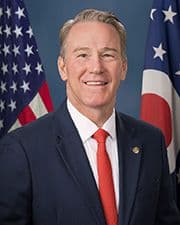


Jon Husted

Jon Husted

Republican · U.S. Senator for Ohio

57 sponsored · 171 cosponsored

Age 59 · In office since 2025

Contact their office: (202) 224-3353 · 304 Russell Senate Office Building, Washington, DC 20510 · Official website

What they got done

Most bills never get a vote. These are the ones they wrote or backed that got somewhere.

Became law (1)

  • Gary Peters (D-MI)

    Cosponsored

    Great Lakes Fishery Research Reauthorization Act

    S. 2878 Public Lands and Natural Resources

    A Democratic bill with 1 Republican cosponsor.

    Became law

    Its purpose is to reauthorize funding used to monitor, assess, and research the Great Lakes Basin. It does this by changing the date in the Further Consolidated Appropriations Act, 2020 from 2025 to 2030.

    Yes· 2 of 15

    • Scored +5

      Does this put more money into scientific research?

      Directly reauthorizes funding for scientific research in the Great Lakes Basin.

    • Scored +5

      Does this better protect air, water and wildlife?

      Extends the ability to monitor and research the health of the Great Lakes Basin ecosystem.

    The opposite

    • Scored -1

      Does this reduce what the federal government spends?

      Reauthorizing funding extends government spending for research through 2030.

Passed Congress — the President's turn (1)

Both chambers passed it. The President signs it into law or vetoes it, and a veto stands unless two-thirds of each chamber vote to pass it anyway. Everything Congress has sent the President →

  • Jerry Moran (R-KS)

    Cosponsored

    Fallen Servicemembers Religious Heritage Restoration Act

    S. 1318 Armed Forces and National Security

    A Republican bill with 11 Democratic cosponsors. See the voting map.

    Passed both chambers

    235191

    This bill consists of two main parts: the Foreign Intelligence Accountability Act and the Anti-CBDC Surveillance State Act.

    Yes· 2 of 5

    • Scored +8

      Does this protect people from being watched or searched?

      The bill strengthens protections against government surveillance and prevents the implementation of a central bank digital currency.

    • Scored +7

      Does this give people more control over their personal data?

      The bill implements stricter oversight on government access to personal data and prohibits central bank digital currency implementation.

    The opposite

    • Scored -5

      Does this give the government more power to monitor people inside the country?

      The bill acts to restrict and curb the expansion of domestic surveillance capabilities of the Federal Reserve and FBI.

    • Scored -3

      Does this give the federal government more power?

      The bill limits the expansion of federal authority regarding digital currency and surveillance.

Passed one chamber, waiting on the other (5)

Halfway: the other chamber has to pass the same text before it can go to the President.

  • Jon Husted (R-OH)

    Their bill

    A bill to amend the Dayton Aviation Heritage Preservation Act of 1992 to adjust the boundary of the Dayton Aviation Heritage National Historical Park, and for other purposes.

    S. 2434 Public Lands and Natural Resources

    A Republican bill with 1 Republican cosponsor.

    Passed the Senate

    With no one objecting, no names recorded

    Now: kept ready for the floor instead of being sent to a committee · Nov 12

    This bill amends the Dayton Aviation Heritage Preservation Act of 1992. Its purpose is to adjust the boundary of the Dayton Aviation Heritage National Historical Park.

    Yes· 2 of 3

    • Scored +3

      Does this better protect public land such as parks and forests?

      The bill expands the land area of the Dayton Aviation Heritage National Historical Park.

    • Scored +1

      Would people in cities be better off under this?

      The land addition occurs within the city of Dayton, Ohio.

    No question was scored the opposite.

  • Gary Peters (D-MI)

    Cosponsored

    GLRI Act of 2026

    S. 528 Environmental Protection

    A Democratic bill with 3 Republican cosponsors.

    Passed the Senate

    With no one objecting, no names recorded

    Now: kept ready for the floor instead of being sent to a committee · Oct 5

    Its main purpose is to reauthorize the Great Lakes Restoration Initiative. Specifically, the legislation updates the Federal Water Pollution Control Act.

    Yes· 2 of 5

    • Scored +8

      Does this better protect air, water and wildlife?

      The bill provides $500,000,000 annually for the Great Lakes Restoration Initiative to protect water quality and ecosystems.

    • Scored +5

      Would Native Americans be better off under this?

      The Great Lakes are vital to the culture and resources of many Native American tribes.

    No question was scored the opposite.

  • Eric Schmitt (R-MO)

    Cosponsored

    National Plan for Epilepsy Act

    S. 494 Health

    A Republican bill with 19 Democratic cosponsors.

    Passed the Senate

    With no one objecting, no names recorded

    Now: kept ready for the floor instead of being sent to a committee · Aug 10

    This bill directs the Secretary of Health and Human Services to review and update existing Federal programs related to epilepsy. This review covers research, prevention, early identification, diagnosis, and treatment.

    Yes· 2 of 4

    • Scored +5

      Would people with disabilities be better off under this?

      The bill focuses on improving diagnosis, treatment, and quality of life for those with epilepsy, a disabling condition.

    • Scored +5

      Does this expand the rights of people with disabilities?

      The bill aims to improve health outcomes, functionality, and quality of life for people living with epilepsy.

    No question was scored the opposite.

And 2 more on their Sponsored and Cosponsored pages.

Resolutions of theirs that were adopted (2)

A resolution is a chamber speaking for itself — a position, a rule or a tribute. Adopting it puts it into effect, but it is not a law.

Still waiting, of the 57 bills they wrote: 3 cleared committee and wait for a first vote, 51 are in committee. Committee is where most bills end, whoever writes them — silence there, not a vote, is the usual way a bill dies.

What their bills would do

Every bill is scored against plain yes-or-no questions. These count their bills — the ones they wrote and the ones they cosponsored — by how each question was answered: yes, or the opposite. Open one to see those bills, where each stands, and why it was scored that way. Scores are made by AI ().

Who their bills would affect

What else they would change

How they voted lately

Their latest votes that decided something, and what each measure would do.

  • U.S. Senate · Nov 20, 2026

    Bipartisan American Affordability and Jobs Act of 2026

    The vote on whether to pass the bill This is the real decision in this chamber. Passing here sends the bill to the other chamber, which must pass it too before it can go to the President.

    Their vote Yea

    This bill aims to accelerate energy projects and infrastructure development by reforming federal environmental reviews, permitting procedures, and court review rules.

    • Scored +5

      Would women be better off under this?

      By protecting settlement money from taxation, the bill provides greater financial security for women survivors of sexual violence.

  • U.S. Senate · Nov 19, 2026

    Directing the President, pursuant to section 5(c) of the War Powers Resolution, to remove United States Armed Forces from hostilities with Iran.

    The vote on whether to adopt the resolution A resolution is one chamber speaking for itself — setting its own rules, taking a position, honouring someone — and it never goes to the President. Agreeing to it is the whole decision.

    Their vote Nay

    This resolution directs the President to remove United States Armed Forces from hostilities with Iran. It uses the authority found under section 5(c) of the War Powers Resolution.

    • Scored +4

      Does this favour talking over confrontation abroad?

      Ending hostilities can pave the way for diplomatic resolutions between the US and Iran.

    • Scored -5

      Does this give the federal government more power?

      The bill limits the Executive branch's power to engage in military hostilities without Congressional approval.

  • U.S. Senate · Nov 18, 2026

    In the nature of a substitute.

    A vote on a proposed change to the bill A vote on one change, not on the bill. A bill can collect dozens of these, and losing one does not stop it.

    Their vote Yea

    This amendment amends the Internal Revenue Code of 1986 to exclude from gross income any damages, other than punitive damages, received on account of sexual acts or sexual contact.

Every vote they cast, and how often they missed one →

On the President’s nominees

The President chooses federal judges, cabinet secretaries, ambassadors and military officers, and the Senate decides whether each one gets the job. Most are confirmed by voice vote, which records no one’s position. In the 119th Congress (2025–2026) the Senate put 228 confirmations to a recorded vote, and confirmed every one.

Their votes to confirm, of the 227 recorded votes held while they served

  • Yes: 227
  • No: None
  • Missed: None

Those votes covered 597 nominees, because the Senate sometimes confirms many in a single vote.

How busy they have been

How many bills they have put their name to over time — volume, not results: most bills never get a vote.

Legislative activity over time