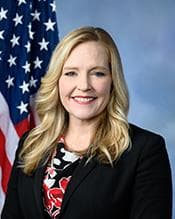
Erin Houchin
Republican · Representative for Indiana's 9th district
49 sponsored · 215 cosponsored
In the House since 2023
Age 50
Contact their office: (202) 225-5315 · 342 Cannon House Office Building, Washington, DC 20515 · Official website
In the 119th Congress (2025–2026)
- Sponsored 49 bills.The typical House member sponsored 25. Bills they wrote, not ones they signed on to.
- 3 bills they backed became law.They cosponsored them.
- 39 passed the House and wait on the Senate.And 1 has passed both chambers and gone to the President.
- Missed 13 of 676 recorded votes (1.9%).The typical House member missed 1.9%. The record doesn’t say why.
- Works most on health and crime and law enforcement.33 and 24 of the 264 bills they wrote or backed.
What they got done
Most bills never get a vote. These are the ones they wrote or backed that got somewhere.
Became law (3)
This Act authorizes the award of 3 Congressional Gold Medals to the members of the 1980 U.S. Olympic Men's Ice Hockey Team. The medals recognize the team's victory over the Soviet Union during the 1980 Winter Olympics.
Became law · 119-HR-452
This joint resolution aims to disapprove a specific rule submitted by the Department of Energy.
Became law · 119-HJRES-75
- Yes: Would business owners be better off under this?The resolution reduces the cost of regulatory compliance for businesses operating commercial refrigeration. +4
- No: Does this better protect air, water and wildlife?By nullifying the rule, the resolution weakens environmental standards for commercial appliances. -5
This joint resolution aims to overturn a specific rule from the Department of Energy. The rule in question involves energy conservation standards for walk-in coolers and walk-in freezers.
Became law · 119-HJRES-24
- Yes: Would farmers be better off under this?Farmers utilizing walk-in coolers and freezers may benefit from reduced equipment costs and easier compliance. +5
- No: Does this cut the pollution that drives climate change?By overturning the energy standards, the resolution likely increases carbon emissions by allowing less efficient equipment to remain in use. -5
Passed Congress — the President's turn (1)
Both chambers passed it. The President signs it into law or vetoes it, and a veto stands unless two-thirds of each chamber vote to pass it anyway. Everything Congress has sent the President →
This bill directs the Secretary of Commerce to conduct a study on the feasibility of manufacturing products for critical infrastructure sectors within the United States.
Passed the Senate with no one objecting, no names recorded · 119-HR-1721
Passed one chamber, waiting on the other (39)
Halfway: the other chamber has to pass the same text before it can go to the President.
This bill amends chapter 3 of title 36, United States Code. The purpose of the bill is to officially designate certain prehistoric creatures. Specifically, it names the American mastodon as the national fossil mammal.
Passed the House by voice vote, no names recorded · 119-HR-9191
This bill amends the Elementary and Secondary Education Act of 1965. The legislation excludes the three-cueing model from comprehensive literacy instruction.
Passed the House by voice vote, no names recorded · 119-HR-7890
- Yes: Would students be better off under this?The bill promotes instructional methods designed to improve fundamental reading skills. +6
This bill allows the Secretary of Energy to send recommendations to the Secretary of Housing and Urban Development regarding changes to energy conservation standards for manufactured homes.
Passed the House 263–147 · 119-HR-5184
- Yes: Would people in rural areas be better off under this?Increases the availability and affordability of housing common in rural areas. +6
- No: Does this cut the pollution that drives climate change?Repeals previously established energy conservation standards, which may lead to lower energy efficiency. -4
And 36 more on their Sponsored and Cosponsored pages.
Resolutions of theirs that were adopted (10)
A resolution is a chamber speaking for itself — a position, a rule or a tribute. Adopting it puts it into effect, but it is not a law.
- Providing for consideration of the bill (H.R. 8646) making appropriations for Agriculture, Rural Development, Food and Drug Administration, and Related Agencies programs for the fiscal year ending September 30, 2027, and for other purposes; providing for consideration of the bill (H.R. 7726) to amend the Child Care and Development Block Grant Act of 1990 to withhold funds from noncompliant States under such Act; providing for consideration of the bill (H.R. 7892) to amend the Higher Education Act of 1965 to require to the Secretary of Education to use an identity fraud detection system to review each FAFSA to determine whether the FAFSA presents a reasonable suspicion of identity fraud; and providing for consideration of the bill (H.R. 8872) to amend part A of title IV of the Social Security Act to target funds to low-income families, strengthen program integrity guardrails for State expenditure of funds, require measurement of improper payments, and establish goals for eliminating fraud and improper payments under the program of block grants to States for temporary assistance for needy families, and for other purposes.
- Electing Members to certain standing committees of the House of Representatives
- Providing for consideration of the bill (H.R. 8029) making appropriations for the Department of Homeland Security for the fiscal year ending September 30, 2026, and for other purposes; providing for consideration of the resolution (H. Res. 1128) expressing the support of the House of Representatives for the Department of Homeland Security; providing for consideration of the bill (H.R. 5103) to establish a program to Beautify the District of Columbia and establish the District of Columbia Safe and Beautiful Commission; providing for consideration of the bill (H.R. 7084) to amend title 46, United States Code, with respect to the types of vessels that may enter or operate in navigable waters of the United States or transfer cargo in any port or place under the jurisdiction of the United States, and for other purposes; and for other purposes.
- Electing a Member to a certain standing committee of the House of Representatives.
- Providing for consideration of the bill (H.R. 4593) to amend the Energy Policy and Conservation Act to revise the definition of showerhead; providing for consideration of the bill (H.R. 5184) to prohibit the Secretary of Energy from enforcing energy efficiency standards applicable to manufactured housing, and for other purposes; and providing for consideration of the bill (H.R. 6938) making consolidated appropriations for the fiscal year ending September 30, 2026, and for other purposes.
- Providing for consideration of the bill (H.R. 5371) making continuing appropriations and extensions for fiscal year 2026, and for other purposes; providing for consideration of the resolution (H. Res. 719) honoring the life and legacy of Charles Charlie James Kirk; and for other purposes.
- Providing for consideration of the bill (H.R. 884) to prohibit individuals who are not citizens of the United States from voting in elections in the District of Columbia and to repeal the Local Resident Voting Rights Amendment Act of 2022; providing for consideration of the bill (H.R. 2056) to require the District of Columbia to comply with federal immigration laws; providing for consideration of the bill (H.R. 2096) to restore the right to negotiate matters pertaining to the discipline of law enforcement officers of the District of Columbia through collective bargaining, to restore the statute of limitations for bringing disciplinary cases against members or civilian employees of the Metropolitan Police Department of the District of Columbia, and for other purposes; and providing for consideration of the bill (S. 331) to amend the Controlled Substances Act with respect to the scheduling of fentanyl-related substances, and for other purposes.
- Providing for consideration of the bill (H.R. 1) to provide for reconciliation pursuant to title II of H. Con. Res. 14.
- Providing for consideration of the joint resolution (H.J. Res. 20) providing for congressional disapproval under chapter 8 of title 5, United States Code, of the rule submitted by the Department of Energy relating to ‘‘Energy Conservation Program: Energy Conservation Standards for Consumer Gas-fired Instantaneous Water Heaters’’; providing for consideration of the joint resolution (H.J. Res. 35) providing for congressional disapproval under chapter 8 of title 5, United States Code, of the rule submitted by the Environmental Protection Agency relating to ‘‘Waste Emissions Charge for Petroleum and Natural Gas Systems: Procedures for Facilitating Compliance, Including Netting and Exemptions’’; and providing for consideration of the concurrent resolution (H. Con. Res. 14) establishing the congressional budget for the United States Government for fiscal year 2025 and setting forth the appropriate budgetary levels for fiscal years 2026 through 2034.
- Electing Members to certain standing committees of the House of Representatives.
Still waiting, of the 49 bills they wrote: 1 cleared committee and waits for a first vote, 34 are in committee. Committee is where most bills end, whoever writes them — silence there, not a vote, is the usual way a bill dies.
What their bills would do
Every bill is scored against plain yes-or-no questions. These count their bills — the ones they wrote and the ones they cosponsored — by how each question was answered: yes, or the opposite. Open one to see those bills, where each stands, and why it was scored that way. Scores are made by AI ().
Who their bills would affect
What else they would change
How they voted lately
Their latest votes that decided something, and what each measure would do.
This bill amends the Employee Retirement Income Security Act of 1974. The main purpose is to provide a clear definition of adequate consideration for certain closely held stock.
A fast-track vote, needing two-thirds to pass — Passed
- Yes: Would retired people be better off under this?Improving the clarity of stock valuation for ESOPs supports more stable retirement transitions. +4
119-S-2403 · roll call 314
This Act provides for improvements to rivers and harbors in the United States and the conservation and development of water and related resources.
A fast-track vote, needing two-thirds to pass — Passed
- Yes: Would Native Americans be better off under this?Directly authorizes land transfers to Tribal entities and prioritizes technical assistance for Tribal communities. +8
- No: Does this reduce what the federal government spends?The bill explicitly increases spending limits and funding authorizations for dozens of regional water resource programs. -5
119-HR-9497 · roll call 313
This bill amends the Public Utility Regulatory Policies Act of 1978 to create a new Federal standard regarding the costs of upgrades for large-load customers.
A fast-track vote, needing two-thirds to pass — Passed
- Yes: Does this keep data centers from raising household electric and water bills?The bill requires large-load customers to cover the full incremental cost of grid upgrades and provide financial assurances, preventing those costs from being passed to households. +7
- No: Would business owners be better off under this?Large-scale non-residential energy consumers face increased costs and financial assurance requirements. -5
119-HR-9340 · roll call 312
On the President’s vetoes
The President can refuse to sign a bill both chambers passed. It becomes law anyway only if two-thirds of the House and two-thirds of the Senate vote to pass it again. A vote against the veto (a Yea) was a vote to make the bill law over the President’s objection; a vote for it (a Nay) was a vote to let the veto stand.
Finish the Arkansas Valley Conduit Act — vetoed Dec 29, 2025
For the vetovoted Nay, to let the veto stand.
The override fell short in the House, 248–177; it needed two-thirds · Jan 8, 2026
Miccosukee Reserved Area Amendments Act — vetoed Dec 29, 2025
For the vetovoted Nay, to let the veto stand.
The override fell short in the House, 236–188; it needed two-thirds · Jan 8, 2026
How busy they have been
How many bills they have put their name to over time — volume, not results: most bills never get a vote.