Bill · S. 1206· Senate(119-S-1206)
Judicial Relief Clarification Act of 2025
- Introduced
- 3/31/2025
- Last activity
- 3/31/2025 — Read twice and referred to the Committee on the Judiciary. (Sponsor introductory remarks on measure: CR S1925-1926)
- Sponsored by
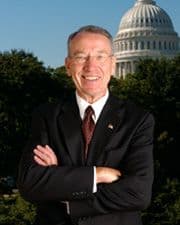
- Chuck Grassley
- Cosponsors
- - 29 - 0
- Introduced
- In Committee
What this bill would do
The Judicial Relief Clarification Act of 2025 aims to amend title 28 of the United States Code to prohibit the issuance of national injunctions. It specifically targets non-party relief by preventing courts from issuing orders that restrain enforcement or compel action against those not directly involved in a case. The bill limits the scope of relief to parties actually before the court. It also modifies rules regarding temporary restraining orders and declaratory judgments. Finally, it restricts judicial review to specific persons defined under the law.
Yes
Does this leave more decisions to the states?+3
By restricting national injunctions, the bill limits the ability of federal courts to obstruct state-level government actions.
The opposite· 3 of 4
Would LGBTQ people be better off under this?-4
Restricting national injunctions may limit the ability of groups to seek broad relief for civil rights protections.
Does this give the federal government more power?-4
The bill limits the ability of courts to issue broad relief against federal and state actions, effectively shifting power toward the executive.
Would households on low incomes be better off under this?-3
Limiting the ability of non-parties to seek relief through injunctions may reduce legal recourse for vulnerable populations.
Who it would affect, and how
Potential Positive Impacts for People
- Limitation of non-party relief: Under Section 2, the bill prevents courts from issuing orders like injunctions or stays that affect people not involved in the lawsuit unless they are represented by a party acting in a representative capacity.
Potential Negative Impacts for People
-
Restriction of judicial relief: Section 2 prevents courts from issuing orders, such as injunctions, vacaturs, or stays, that would restrain enforcement or compel action against non-parties unless they are represented in a representative capacity.
-
Changes to temporary restraining orders: Section 3 modifies title 28 to include temporary restraining orders that purport to restrain enforcement of or compel action regarding statutes, regulations, orders, or executive actions by the United States or various States and their officials.
-
Modification of declaratory judgments: Section 4 amends section 2201(a) to require that a party be before the court for a declaratory judgment.
-
Limits on judicial review: Section 5 amends chapter 7 of title 5 to limit judicial review to a person, as defined in section 551, before the court, and strikes the phrase "and set aside" from section 706.
Groups and Interests Ranking
Every group the model scored this bill for, from -10 to +10. Hover a score for the reason it gave.
- Demographic And Interest Groups
- Good For L G B T Q Community-4Good For Low Income Households-3
- Governance And Ideology
- Increase States Rights+3Increases Federal Power-4Improves Due Process-3
- 5/6/2025
- 1 Cosponsor added.
- 4/10/2025
- 1 Cosponsor added.
- 4/7/2025
- 1 Cosponsor added.
- 4/4/2025
- 2 Cosponsors added.
- 4/3/2025
- 1 Cosponsor added.
- 4/2/2025
- 2 Cosponsors added.
- 3/31/2025
- Read twice and referred to the Committee on the Judiciary. (Sponsor introductory remarks on measure: CR S1925-1926)
- 21 Cosponsors added.
- Introduced in Senate
 Marsha Blackburn
Republican · Tennessee
 John Barrasso
Republican · Wyoming
 Jim Banks
Republican · Indiana
 Ted Budd
Republican · North Carolina
 Katie Britt
Republican · Alabama
 John Cornyn
Republican · Texas
 Bill Cassidy
Republican · Louisiana
 Kevin Cramer
Republican · North Dakota
 Ted Cruz
Republican · Texas
 Steve Daines
Republican · Montana
 Joni Ernst
Republican · Iowa
 Deb Fischer
Republican · Nebraska
 Lindsey Graham
Republican · South Carolina
 Bill Hagerty
Republican · Tennessee
 Cindy Hyde-Smith
Republican · Mississippi
 Jon Husted
Republican · Ohio
 James Justice
Republican · West Virginia
 John Kennedy
Republican · Louisiana
 Cynthia Lummis
Republican · Wyoming
 James Lankford
Republican · Oklahoma
 Mike Lee
Republican · Utah
 Roger Marshall
Republican · Kansas
 Bernie Moreno
Republican · Ohio
 Ashley Moody
Republican · Florida
 Dan Sullivan
Republican · Alaska
 Eric Schmitt
Republican · Missouri
 Tim Sheehy
Republican · Montana
 Tommy Tuberville
Republican · Alabama
 Thomas Tillis
Republican · North Carolina