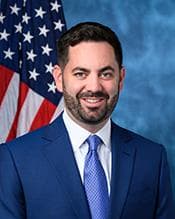


Michael Lawler

Michael Lawler

Republican · U.S. Representative for New York's 17th district

132 sponsored · 1132 cosponsored

Age 40 · In office since 2023

Contact their office: (202) 225-6506 · 324 Cannon House Office Building, Washington, DC 20515 · Official website

What they got done

Most bills never get a vote. These are the ones they wrote or backed that got somewhere.

Became law (11)

  • Christopher Smith (R-NJ)

    Cosponsored

    United States Commission on International Religious Freedom Reauthorization Act of 2026

    H.R. 1744 International Affairs

    A Republican bill with 6 Democratic cosponsors.

    Became law

    This bill extends the operations and funding for the United States Commission on International Religious Freedom. The bill updates the timeline for annual appropriations.

    Yes

    • Scored +5

      Does this protect the freedom to practise a religion?

      The bill extends the authorization and funding for the Commission on International Religious Freedom to ensure continued oversight of religious freedom globally.

    • Scored +3

      Does this send more money or help to other countries?

      The bill reauthorizes appropriations necessary for the Commission's work on international religious freedom issues.

    No question was scored the opposite.
  • David Valadao (R-CA)

    Cosponsored

    Romance Scam Prevention Act

    H.R. 2481 Commerce

    A Republican bill with 4 Democratic cosponsors.

    Became law

    This bill requires online dating service providers to send fraud ban notifications to members who have communicated with someone whose account was banned for fraud.

    Yes· 2 of 4

    • Scored +5

      Does this give people more protection from unfair business practices?

      The bill enhances consumer protection by requiring dating services to notify users of potential fraud risks.

    • Scored +3

      Does this protect people from AI fakes, scams and automated decisions about their lives?

      The bill protects individuals from scams by requiring dating service providers to send fraud ban notifications.

    The opposite

    • Scored -4

      Does this leave more decisions to the states?

      The bill restricts the ability of states and political subdivisions to maintain or enforce their own dating service notification standards.

  • Jimmy Panetta (D-CA)

    Cosponsored

    Lindsey O. Graham Sanctioning Russia and Iran Act of 2026

    H.R. 5334 International Affairs

    A Democratic bill with 5 Republican cosponsors. See the voting map.

    Became law

    The House voted 262–159 on Sep 16.

    This bill aims to crack down on the Russian Federation through heavy economic sanctions, investment bans, and increased import duties.

    Yes· 2 of 8

    • Scored +7

      Does this strengthen ties with allied countries?

      Coordinates sanctions with the G7, EU, and Five Eyes alliance.

    • Scored +6

      Does this send more money or help to other countries?

      Allows loans to Ukraine to be repaid using immobilized Russian sovereign assets.

    The opposite· 2 of 13

    • Scored -6

      Does this make trade with other countries easier?

      Imposes high tariffs on Russia and other countries facilitating sanctions evasion.

    • Scored -5

      Would billionaires be better off under this?

      Directly targets Russian oligarchs and high-net-worth individuals supporting the Russian government.

And 8 more on their Sponsored and Cosponsored pages.

Passed Congress — the President's turn (2)

Both chambers passed it. The President signs it into law or vetoes it, and a veto stands unless two-thirds of each chamber vote to pass it anyway. Everything Congress has sent the President →

  • Ritchie Torres (D-NY)

    Cosponsored

    Setting Consumer Standards for Lithium-Ion Batteries Act

    H.R. 973 Commerce

    A Democratic bill with 6 Republican cosponsors. See the voting map.

    Passed both chambers

    The House voted 365–42 on Apr 28.

    With no one objecting, no names recorded

    This bill requires the Consumer Product Safety Commission to set safety standards for certain batteries used in light electric vehicles, eBikes, and personal e-mobility devices.

    Yes· 2 of 4

    • Scored +7

      Does this give people more protection from unfair business practices?

      The bill mandates safety standards for lithium-ion batteries used in eBikes and other personal mobility devices to protect consumers.

    • Scored +5

      Does this make what the government does easier for the public to see?

      The bill requires the Commission to submit a detailed report to Congress regarding battery-related hazards and manufacturer information.

    No question was scored the opposite.
  • Ann Wagner (R-MO)

    Cosponsored

    Financial Exploitation Prevention Act of 2025

    H.R. 2478 Finance and Financial Sector

    A Republican bill with 4 Democratic cosponsors. See the voting map.

    Passed both chambers

    The House voted 414–2 on Jun 25.

    With no one objecting, no names recorded

    This bill amends the Investment Company Act of 1940.

    Yes· 2 of 5

    • Scored +7

      Would people over 65 be better off under this?

      The bill protects adults aged 65 and older from financial exploitation by allowing trusted contacts to be notified and payment redemptions to be paused.

    • Scored +7

      Would retired people be better off under this?

      Retirees benefit from safeguards that help protect their investment accounts from potential financial exploitation.

    No question was scored the opposite.

Passed one chamber, waiting on the other (100)

Halfway: the other chamber has to pass the same text before it can go to the President.

And 97 more on their Sponsored and Cosponsored pages.

Still waiting, of the 132 bills they wrote: 1 cleared committee and waits for a first vote, 124 are in committee. Committee is where most bills end, whoever writes them — silence there, not a vote, is the usual way a bill dies.

What their bills would do

Every bill is scored against plain yes-or-no questions. These count their bills — the ones they wrote and the ones they cosponsored — by how each question was answered: yes, or the opposite. Open one to see those bills, where each stands, and why it was scored that way. Scores are made by AI ().

Who their bills would affect

What else they would change

How they voted lately

Their latest votes that decided something, and what each measure would do.

  • U.S. House · Nov 19, 2026

    Preventive Health Savings Act

    A fast-track vote, needing two-thirds to pass The House sets aside its normal procedure to move quickly: no amendments, little debate, and a two-thirds bar instead of a simple majority. It is used for measures expected to be uncontroversial, so a bill that fails here failed despite broad expectations that it would not.

    Their vote Yea

    This bill amends the Congressional Budget Act of 1974 regarding how preventive health savings are scored.

    • Scored +3

      Does this reduce what the federal government spends?

      By highlighting reductions in budget outlays through preventive health, the bill facilitates the identification of potential spending reductions.

  • U.S. House · Nov 18, 2026

    Earth MRI Reauthorization Act of 2026

    A fast-track vote, needing two-thirds to pass The House sets aside its normal procedure to move quickly: no amendments, little debate, and a two-thirds bar instead of a simple majority. It is used for measures expected to be uncontroversial, so a bill that fails here failed despite broad expectations that it would not.

    Their vote Yea

    This bill updates the Infrastructure Investment and Jobs Act to reauthorize the Earth Mapping Resources Initiative.

    • Scored +7

      Does this put more money into scientific research?

      Authorizes 84 million dollars to update and expand geological mapping and scientific data collection methods.

  • U.S. House · Nov 18, 2026

    Common Sense 250 Act of 2026

    A fast-track vote, needing two-thirds to pass The House sets aside its normal procedure to move quickly: no amendments, little debate, and a two-thirds bar instead of a simple majority. It is used for measures expected to be uncontroversial, so a bill that fails here failed despite broad expectations that it would not.

    Their vote Yea

    Its main purpose is to officially approve the location for a commemorative work honoring Thomas Paine. The monument is designated to be placed within a specific zone known as Area I in Washington, DC, and its environs.

Every vote they cast, and how often they missed one →

On the President’s vetoes

A vetoed bill becomes law only if two-thirds of both chambers pass it again. The President can refuse to sign a bill both chambers passed. It becomes law anyway only if two-thirds of the House and two-thirds of the Senate vote to pass it again. A vote against the veto (a Yea) was a vote to make the bill law over the President’s objection; a vote for it (a Nay) was a vote to let the veto stand.

How busy they have been

How many bills they have put their name to over time — volume, not results: most bills never get a vote.

Legislative activity over time