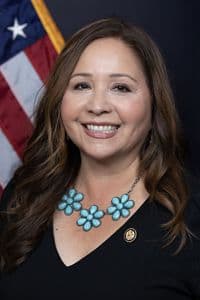
Rep. Adelita S. Grijalva

Adelita S. Grijalva

DemocratDemocrat · Representative for Arizona's 7th district

17 sponsored · 514 cosponsored

In the House since 2025

Age 56

Contact their office: (202) 225-2435 · 1203 Longworth House Office Building, Washington, DC 20515 · Official website

Of the bills they sponsored: 17 are in committee.

The paragraph under each bill and the scores beside it were written by an AI model from the bill's text; the rest is the record.

In committee17 billsIntroduced and handed to a committee in the chamber it started in.

What happens next: The committee holds it, and most bills are never heard from again. A hearing or a committee vote would be news; silence is the usual outcome, and it kills the bill without anyone voting against it.

Rep. Grijalva
Democrat
Labor and Employment119-HR-10557

Protection of Social Security Benefits Restoration Act

Introduced in the House · Sep 24

Now: handed to a committee to examine — Committee on the Judiciary, and in addition to the Committee on Ways and Means, for a period to be subsequently determined by the Speaker, in each case for consideration of such provisions as fall within the jurisdiction of the committee concerned · Sep 24

The main goal of the bill is to restore protections for certain benefits so they cannot be taken away through an administrative offset.

Yes· 2 of 7

  • Would people over 65 be better off under this?+8The bill protects Social Security and related benefits from administrative offsets, directly benefiting older Americans who rely on these funds.
  • Would retired people be better off under this?+8Retirees heavily depend on Social Security and railroad retirement benefits, which are explicitly protected from administrative offsets under this legislation.

The opposite

  • No question was scored the opposite.
Rep. Grijalva
Democrat
Education119-HR-10438

SYLLABLE Act of 2026

Introduced in the House · Sep 16

Now: handed to a committee to examine — Committee on Education and Workforce · Sep 16

The bill establishes high-quality dual language immersion programs in low-income communities. It authorizes the Secretary of Education to award up to five grants to eligible partnerships for developing these programs.

Yes· 2 of 7

  • Would households on low incomes be better off under this?+6The bill specifically directs grant funding toward establishing dual language programs that serve children from low-income families and high-need schools.
  • Would children be better off under this?+6The legislation establishes high-quality dual language immersion programs from preschool through fifth grade to improve school readiness and academic achievement.

The opposite

  • No question was scored the opposite.
Rep. Grijalva
Democrat
Education119-HR-10437

FLUENT Act

Introduced in the House · Sep 16

Now: handed to a committee to examine — Committee on Education and Workforce · Sep 16

This bill creates a competitive grant program to help improve the English language and literacy skills of English language learners and their families.

Yes· 2 of 11

  • Would immigrants be better off under this?+8The legislation is specifically designed to improve the English language, literacy skills, and economic advancement of immigrant families.
  • Would households on low incomes be better off under this?+7Grant providers are required to prioritize English language learners with the greatest economic, educational, and social need.

The opposite

  • Does this reduce what the federal government spends?-2The bill authorizes an appropriation of $75,000,000 annually for fiscal years 2027 through 2031, increasing federal spending.
Rep. Grijalva
Democrat
Education119-HR-10436

Reaching English Learners Act

Introduced in the House · Sep 16

Now: handed to a committee to examine — Committee on Education and Workforce · Sep 16

This bill directs the Secretary of Education to award competitive grants to eligible partnerships. These grants aim to improve how teacher candidates are prepared to instruct English learners.

Yes· 2 of 15

  • Would children be better off under this?+5The bill trains teachers to better support English learner students and children with disabilities in early childhood and K-12 education.
  • Would immigrants be better off under this?+5Immigrant children who are English learners will receive significantly improved instructional support and resources from better-prepared teachers.

The opposite

  • No question was scored the opposite.
Rep. Grijalva
Democrat
Labor and Employment119-HR-10273

Fairness for Farm Workers Act

Introduced in the House · Sep 3

Now: handed to a committee to examine — Committee on Education and Workforce · Sep 3

This bill amends the Fair Labor Standards Act of 1938 to provide increased labor law protections for agricultural workers.

Yes· 2 of 10

  • Would Hispanic Americans be better off under this?+8Strongly benefits Hispanic workers who make up a large portion of the US farm workforce.
  • Would households on low incomes be better off under this?+8Significantly increases wages for farm workers through overtime pay.

The opposite· 2 of 4

  • Would farmers be better off under this?-6Imposes new costs and reduces exemptions for farm operators.
  • Would business owners be better off under this?-5Increases operational costs for farm owners due to overtime requirements.
Rep. Grijalva
Democrat
Civil Rights and Liberties, Minority Issues119-HRES-1385

Celebrating the accomplishments of title IX of the Education Amendments of 1972, also known as the Patsy Takemoto Mink Equal Opportunity in Education Act, and recognizing the need to continue pursuing the goal of educational opportunities for all women and girls.

Introduced in the House · Jun 24

Now: handed to a committee to examine — Committee on Education and Workforce · Jun 24

This resolution celebrates the historical accomplishments of Title IX, also known as the Patsy Takemoto Mink Equal Opportunity in Education Act.

Yes· 2 of 9

  • Would women be better off under this?+8The resolution explicitly highlights and seeks to defend the rights and opportunities of women and girls in education and athletics.
  • Would LGBTQ people be better off under this?+7The text advocates for the protection of transgender, nonbinary, and intersex students from discrimination and weaponization of Title IX.

The opposite

  • Does this give the federal government more power?-3The resolution opposes the transfer of enforcement responsibilities to the Department of Justice, advocating for continued Department of Education oversight.
Rep. Grijalva
Democrat
Immigration119-HR-8971

Veterans Visa and Protection Act of 2026

Introduced in the House · May 21

Now: handed to a committee to examine — Committee on Health · Jun 12

This bill directs the Secretary of Homeland Security to create a program for eligible veterans to return to or remain in the United States as permanent residents.

Yes· 2 of 5

  • Would veterans be better off under this, taking everything together?+9The bill provides substantial benefits, including permanent residency and protection from removal, for qualifying veterans.
  • Does this make it easier for immigrants already here to become citizens?+9The bill creates a clear path to permanent residency and naturalization for eligible veterans through their military service.

The opposite

  • No question was scored the opposite.
Rep. Grijalva
Democrat
Environmental Protection119-HR-8850

Extinction Prevention Act of 2026

Introduced in the House · May 15

Now: handed to a committee to examine — Committee on Natural Resources · May 15

This bill establishes dedicated funds to support the conservation of specific wildlife and ecosystems.

Yes· 2 of 10

  • Does this better protect air, water and wildlife?+10The bill creates dedicated funds to conserve threatened and endangered species of butterflies, plants, mussels, and fish.
  • Would Native Americans be better off under this?+5The bill requires seeking free, informed, and prior consent from indigenous communities for certain projects.

The opposite

  • No question was scored the opposite.
Rep. Grijalva
Democrat
Education119-HRES-1139

Supporting the goals and ideals of "National Middle-Level Education Month".

Introduced in the House · Mar 26

Now: handed to a committee to examine — Committee on Education and Workforce · Mar 26

This resolution supports the goals and ideals of "National Middle-Level Education Month." It recognizes that schools for students aged 10 to 15 play a critical function in the educational system.

Yes· 2 of 6

  • Would children be better off under this?+2The resolution supports the unique developmental and educational needs of students aged 10 to 15.
  • Would students be better off under this?+2The resolution advocates for a safe, challenging, and supportive learning environment for young adolescents.

The opposite

  • No question was scored the opposite.

Showing the newest 10 — show all 17 →