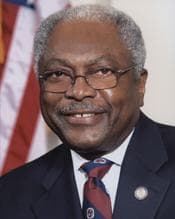

James E. Clyburn

James E. Clyburn

Democrat · U.S. Representative for South Carolina's 6th district

3 sponsored · 72 cosponsored

Age 86 · In office since 1993

Contact their office: (202) 225-3315 · 274 Cannon House Office Building, Washington, DC 20515 · Official website

What they got done

Most bills never get a vote. These are the ones they wrote or backed that got somewhere.

Passed one chamber, waiting on the other (3)

Halfway: the other chamber has to pass the same text before it can go to the President.

  • James Clyburn (D-SC)

    Their bill

    Renewing the African American Civil Rights Network Act

    H.R. 9269 Civil Rights and Liberties, Minority Issues

    A Democratic bill with 5 Republican cosponsors.

    Passed the House

    By voice vote, no names recorded

    Now: handed to a committee to examine — Committee on Energy and Natural Resources · Nov 18

    This bill was received and read twice in the Senate on November 18, 2026. The legislation extends the authorization of the African American Civil Rights Network.

    Yes

    • Scored +5

      Would Black Americans be better off under this?

      The bill extends the authorization of a network specifically focused on African American civil rights.

    • Scored +3

      Does this narrow racial gaps in how people are treated?

      The bill supports the continued operation of a network dedicated to African American civil rights.

    No question was scored the opposite.

  • Daniel Goldman (D-NY)

    Cosponsored

    25th Anniversary of 9/11 Commemorative Coin Act

    H.R. 1993 Finance and Financial Sector

    A Democratic bill with 103 Republican cosponsors. See the voting map.

    Passed the House

    4150

    Now: arrived in the other chamber; nothing has happened to it there yet · May 21

    This Act directs the Secretary of the Treasury to mint gold and silver coins to commemorate the 25th anniversary of the September 11, 2001, terrorist attacks.

    Yes· 2 of 5

    • Scored +5

      Does this make the government pay for what it commits to?

      The Act ensures that the coin program results in no net cost to the Federal Government.

    • Scored +3

      Would people in cities be better off under this?

      The Act directs funds toward the National September 11 Memorial and Museum located in New York City.

    No question was scored the opposite.

  • Jared Golden (D-ME)

    Cosponsored

    Protect America's Workforce Act

    H.R. 2550 Labor and Employment

    A Democratic bill with 9 Republican cosponsors. See the voting map.

    Passed the House

    231195

    Now: arrived in the other chamber; nothing has happened to it there yet · Dec 15

    This bill completely cancels a specific Executive order issued on March 27, 2025, that was about exclusions from federal labor-management relations programs.

    Yes· 2 of 3

    • Scored +9

      Would union members be better off under this?

      The bill directly safeguards federal employee unions by nullifying an executive order against labor relations and upholding current collective bargaining agreements.

    • Scored +8

      Does this strengthen the rights of workers to organise?

      The bill nullifies an executive order restricting federal labor-management relations and protects existing collective bargaining agreements.

    No question was scored the opposite.

Still waiting, of the 3 bills they wrote: 2 are in committee. Committee is where most bills end, whoever writes them — silence there, not a vote, is the usual way a bill dies.

What their bills would do

Every bill is scored against plain yes-or-no questions. These count their bills — the ones they wrote and the ones they cosponsored — by how each question was answered: yes, or the opposite. Open one to see those bills, where each stands, and why it was scored that way. Scores are made by AI ().

Who their bills would affect

What else they would change

How they voted lately

Their latest votes that decided something, and what each measure would do.

  • U.S. House · Nov 19, 2026

    Preventive Health Savings Act

    A fast-track vote, needing two-thirds to pass The House sets aside its normal procedure to move quickly: no amendments, little debate, and a two-thirds bar instead of a simple majority. It is used for measures expected to be uncontroversial, so a bill that fails here failed despite broad expectations that it would not.

    Their vote Yea

    This bill amends the Congressional Budget Act of 1974 regarding how preventive health savings are scored.

    • Scored +3

      Does this reduce what the federal government spends?

      By highlighting reductions in budget outlays through preventive health, the bill facilitates the identification of potential spending reductions.

  • U.S. House · Nov 18, 2026

    Earth MRI Reauthorization Act of 2026

    A fast-track vote, needing two-thirds to pass The House sets aside its normal procedure to move quickly: no amendments, little debate, and a two-thirds bar instead of a simple majority. It is used for measures expected to be uncontroversial, so a bill that fails here failed despite broad expectations that it would not.

    Their vote Yea

    This bill updates the Infrastructure Investment and Jobs Act to reauthorize the Earth Mapping Resources Initiative.

    • Scored +7

      Does this put more money into scientific research?

      Authorizes 84 million dollars to update and expand geological mapping and scientific data collection methods.

  • U.S. House · Nov 18, 2026

    Common Sense 250 Act of 2026

    A fast-track vote, needing two-thirds to pass The House sets aside its normal procedure to move quickly: no amendments, little debate, and a two-thirds bar instead of a simple majority. It is used for measures expected to be uncontroversial, so a bill that fails here failed despite broad expectations that it would not.

    Their vote Yea

    Its main purpose is to officially approve the location for a commemorative work honoring Thomas Paine. The monument is designated to be placed within a specific zone known as Area I in Washington, DC, and its environs.

Every vote they cast, and how often they missed one →

On the President’s vetoes

A vetoed bill becomes law only if two-thirds of both chambers pass it again. The President can refuse to sign a bill both chambers passed. It becomes law anyway only if two-thirds of the House and two-thirds of the Senate vote to pass it again. A vote against the veto (a Yea) was a vote to make the bill law over the President’s objection; a vote for it (a Nay) was a vote to let the veto stand.

How busy they have been

How many bills they have put their name to over time — volume, not results: most bills never get a vote.

Legislative activity over time