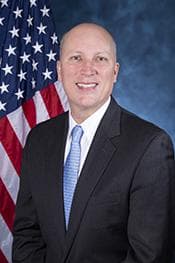
Chip Roy
Republican · Representative for Texas's 21st district
68 sponsored · 143 cosponsored
In the House since 2019
Age 54
Contact their office: (202) 225-4236 · 103 Cannon House Office Building, Washington, DC 20515 · Official website
In the 119th Congress (2025–2026)
- Sponsored 68 bills.The typical House member sponsored 25. Bills they wrote, not ones they signed on to.
- None of the bills they wrote or backed has become law yet.Most bills never get a vote, from any member.
- 14 passed the House and wait on the Senate.The Senate has to pass the same text before it can become law.
- Missed 38 of 676 recorded votes (5.6%).The typical House member missed 1.9%. The record doesn’t say why.
- Works most on immigration and crime and law enforcement.40 and 23 of the 211 bills they wrote or backed.
What they got done
Most bills never get a vote. These are the ones they wrote or backed that got somewhere.
Passed one chamber, waiting on the other (14)
Halfway: the other chamber has to pass the same text before it can go to the President.
This bill directs the Attorney General to submit a report to Congress regarding all criminal statutory offenses.
A Senate committee approved it and sent it to the floor · 119-HR-2159
- Yes: Does this make what the government does easier for the public to see?The act mandates the creation of public indexes for criminal offenses, greatly increasing transparency of federal regulations. +5
This bill amends the National Voter Registration Act of 1993. It requires individuals to provide documentary proof of United States citizenship to register for Federal elections.
Passed the House 220–208 · 119-HR-22
- Yes: Does this make elections run better?The bill seeks to ensure only citizens vote, which some argue improves the integrity of the electoral process. +3
- No: Would immigrants be better off under this?The bill introduces significant barriers for immigrants, even legal residents, mistakenly attempting to register or facing confusion about eligibility. -8
This bill seeks to impose sanctions on the International Criminal Court (ICC) if it attempts to investigate, arrest, detain, or prosecute protected persons from the United States or its allies.
Passed the House 243–140 · 119-HR-23
- Yes: Does this strengthen ties with allied countries?The bill seeks to protect the interests and officials of United States allies from ICC jurisdiction. +3
- No: Would people with substantial wealth be better off under this?The bill allows for the blocking of property and interests in property of certain foreign persons. -5
And 11 more on their Sponsored and Cosponsored pages.
Resolutions of theirs that were adopted (5)
A resolution is a chamber speaking for itself — a position, a rule or a tribute. Adopting it puts it into effect, but it is not a law.
- Providing for consideration of the bill (H.R. 4690) to amend the Energy Conservation and Production Act to repeal certain Federal building energy efficiency performance standards, and for other purposes; providing for consideration of the resolution (H. Res. 1182) expressing support for rural communities across the United States as stewards of the environment, major suppliers of United States energy resources, critical providers of food production and manufacturing capacity, and drivers of national economic stability, and recognizing the work of the House of Representatives in the 119th Congress in support of those vital communities; providing for consideration of the bill (H.R. 1897) to amend the Endangered Species Act of 1973 to optimize conservation through resource prioritization, incentivize wildlife conservation on private lands, provide for greater incentives to recover listed species, create greater transparency and accountability in recovering listed species, streamline the permitting process, eliminate barriers to conservation, and restore congressional intent; and providing for consideration of the bill (H.R. 5587) to amend the Geothermal Steam Act of 1970 to waive the requirement for a Federal drilling permit for certain activities, to exempt certain activities from the requirements of the National Environmental Policy Act of 1969, and for other purposes.
- Providing for consideration of the bill (S. 1383) to establish the Veterans Advisory Committee on Equal Access, and for other purposes; providing for consideration of the bill (H.R. 2189) to modernize Federal firearms laws to account for advancements in technology and less-than-lethal weapons, and for other purposes; providing for consideration of the bill (H.R. 261) to amend the National Marine Sanctuaries Act to prohibit requiring an authorization for the installation, continued presence, operation, maintenance, repair, or recovery of undersea fiber optic cables in a national marine sanctuary if such activities have previously been authorized by a Federal or State agency; providing for consideration of the bill (H.R. 3617) to amend the Department of Energy Organization Act to secure the supply of critical energy resources, including critical minerals and other materials, and for other purposes; and waiving a requirement of clause 6(a) of rule XIII with respect to consideration of certain resolutions reported from the Committee on Rules.
- Expressing condolences and support for the victims of the July 4 flooding in Texas, honoring acts of heroism, and committing to stand with those impacted by these floods.
- Providing for consideration of the bill (H.R. 2240) to require the Attorney General to develop reports relating to violent attacks against law enforcement officers, and for other purposes; providing for consideration of the bill (H.R. 2243) to amend title 18, United States Code, to improve the Law Enforcement Officer Safety Act and provisions relating to the carrying of concealed weapons by law enforcement officers, and for other purposes; and providing for consideration of the bill (H.R. 2255) to allow Federal law enforcement officers to purchase retired service weapons, and for other purposes.
- Providing for consideration of the joint resolution (H.J. Res. 60) providing for congressional disapproval under chapter 8 of title 5, United States Code, of the rule submitted by the National Park Service relating to "Glen Canyon National Recreation Area: Motor Vehicles"; providing for consideration of the joint resolution (H.J. Res. 78) providing for congressional disapproval under chapter 8 of title 5, United States Code, of the rule submitted by the United States Fish and Wildlife Service relating to "Endangered and Threatened Wildlife and Plants; Endangered Species Status for the San Francisco Bay-Delta Distinct Population Segment of the Longfin Smelt"; providing for consideration of the joint resolution (H.J. Res. 87) providing congressional disapproval under chapter 8 of title 5, United States Code, of the rule submitted by the Environmental Protection Agency relating to "California State Motor Vehicle and Engine Pollution Control Standards; Heavy-Duty Vehicle and Engine Emission Warranty and Maintenance Provisions; Advanced Clean Trucks; Zero Emission Airport Shuttle; Zero-Emission Power Train Certification; Waiver of Preemption; Notice of Decision"; providing for consideration of the joint resolution (H.J. Res. 88) providing congressional disapproval under chapter 8 of title 5, United States Code, of the rule submitted by the Environmental Protection Agency relating to "California State Motor Vehicle and Engine Pollution Control Standards; Advanced Clean Cars II; Waiver of Preemption; Notice of Decision"; providing for consideration of the joint resolution (H.J. Res. 89) providing congressional disapproval under chapter 8 of title 5, United States Code, of the rule submitted by the Environmental Protection Agency relating to "California State Motor Vehicle and Engine and Nonroad Engine Pollution Control Standards; The "Omnibus" Low NOX Regulation; Waiver of Preemption; Notice of Decision"; and for other purposes.
Still waiting, of the 68 bills they wrote: 60 are in committee. Committee is where most bills end, whoever writes them — silence there, not a vote, is the usual way a bill dies.
What their bills would do
Every bill is scored against plain yes-or-no questions. These count their bills — the ones they wrote and the ones they cosponsored — by how each question was answered: yes, or the opposite. Open one to see those bills, where each stands, and why it was scored that way. Scores are made by AI ().
Who their bills would affect
What else they would change
How they voted lately
Their latest votes that decided something, and what each measure would do.
This bill amends the Employee Retirement Income Security Act of 1974. The main purpose is to provide a clear definition of adequate consideration for certain closely held stock.
A fast-track vote, needing two-thirds to pass — Passed
- Yes: Would retired people be better off under this?Improving the clarity of stock valuation for ESOPs supports more stable retirement transitions. +4
119-S-2403 · roll call 314
This Act provides for improvements to rivers and harbors in the United States and the conservation and development of water and related resources.
A fast-track vote, needing two-thirds to pass — Passed
- Yes: Would Native Americans be better off under this?Directly authorizes land transfers to Tribal entities and prioritizes technical assistance for Tribal communities. +8
- No: Does this reduce what the federal government spends?The bill explicitly increases spending limits and funding authorizations for dozens of regional water resource programs. -5
119-HR-9497 · roll call 313
This bill amends the Public Utility Regulatory Policies Act of 1978 to create a new Federal standard regarding the costs of upgrades for large-load customers.
A fast-track vote, needing two-thirds to pass — Passed
- Yes: Does this keep data centers from raising household electric and water bills?The bill requires large-load customers to cover the full incremental cost of grid upgrades and provide financial assurances, preventing those costs from being passed to households. +7
- No: Would business owners be better off under this?Large-scale non-residential energy consumers face increased costs and financial assurance requirements. -5
119-HR-9340 · roll call 312
On the President’s vetoes
The President can refuse to sign a bill both chambers passed. It becomes law anyway only if two-thirds of the House and two-thirds of the Senate vote to pass it again. A vote against the veto (a Yea) was a vote to make the bill law over the President’s objection; a vote for it (a Nay) was a vote to let the veto stand.
Finish the Arkansas Valley Conduit Act — vetoed Dec 29, 2025
For the vetovoted Nay, to let the veto stand.
The override fell short in the House, 248–177; it needed two-thirds · Jan 8, 2026
Miccosukee Reserved Area Amendments Act — vetoed Dec 29, 2025
For the vetovoted Nay, to let the veto stand.
The override fell short in the House, 236–188; it needed two-thirds · Jan 8, 2026
How busy they have been
How many bills they have put their name to over time — volume, not results: most bills never get a vote.