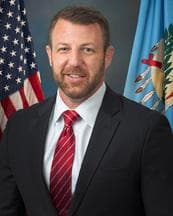
Markwayne Mullin
Republican · Senator for Oklahoma · no longer serving
23 sponsored · 157 cosponsored
Served 2013–2026
Age 49
In the 119th Congress (2025–2026)
- Sponsored 23 bills.The typical senator sponsored 61. Bills they wrote, not ones they signed on to.
- 4 bills they backed became law.1 they wrote, 3 they cosponsored.
- 6 passed the Senate and wait on the House.The House has to pass the same text before it can become law.
- Missed 40 of the 723 recorded votes the Senate held while they were serving in the 119th Congress (2025–2026), or 5.5%.The typical senator missed 2.2%.
- Works most on health and native americans.30 and 19 of the 180 bills they wrote or backed.
What they got done
Most bills never get a vote. These are the ones they wrote or backed that got somewhere.
Became law (4)
- Their billA bill to provide for the equitable settlement of certain Indian land disputes regarding land in Illinois, and for other purposes.Sep 25, 2026
This bill provides for the equitable settlement of certain Indian land disputes regarding land in Illinois.
Became law · 119-S-550
- Yes: Would Native Americans be better off under this?Directly benefits the Miami Tribe of Oklahoma by providing a path to settle land disputes. +6
- They cosponsoredA bill to designate the facility of the United States Postal Service located at 201 West Oklahoma Avenue in Guthrie, Oklahoma, as the "Oscar J. Upham Post Office".Dec 18, 2025
This bill designates a specific United States Postal Service facility in Guthrie, Oklahoma. The facility is located at 201 West Oklahoma Avenue.
Became law · 119-S-2283
This bill amends the Wildfire Suppression Aircraft Transfer Act of 1996. It serves to reauthorize the sale of aircraft and parts from the Department of Defense for wildfire suppression.
Became law · 119-S-160
- Yes: Would people in rural areas be better off under this?Enhanced firefighting capabilities benefit rural residents who are more susceptible to wildfire risks. +5
And 1 more on their Sponsored and Cosponsored pages.
Passed one chamber, waiting on the other (6)
Halfway: the other chamber has to pass the same text before it can go to the President.
This bill amends the Stored Communications Act to include Tribal courts as courts of competent jurisdiction.
Passed the Senate with no one objecting, no names recorded · 119-S-1574
- Yes: Would Native Americans be better off under this?Significantly empowers Tribal courts and governments by granting them the authority to access electronic evidence. +8
- No: Does this protect people from being watched or searched?Enables Tribal authorities to access electronic records and potentially delay notification to the individual. -3
This bill aims to amend the Public Health Service Act. It authorizes the Secretary of Health and Human Services to establish a specific program directed by the NIH.
Passed the Senate by voice vote, no names recorded · 119-S-1838
- Yes: Would people with disabilities be better off under this?The bill provides significant benefits through research and clinical trial expansion for individuals with Down syndrome. +9
This Act aims to amend the Older Americans Act of 1965. It provides updated funding authorizations for fiscal years 2026 through 2030 across various aging-related programs.
Passed the Senate with no one objecting, no names recorded · 119-S-2120
- Yes: Would people over 65 be better off under this?The bill provides significant increased funding and services specifically for older individuals. +10
And 3 more on their Sponsored and Cosponsored pages.
Still waiting, of the 23 bills they wrote: 1 cleared committee and waits for a first vote, 21 are in committee. Committee is where most bills end, whoever writes them — silence there, not a vote, is the usual way a bill dies.
What their bills would do
Every bill is scored against plain yes-or-no questions. These count their bills — the ones they wrote and the ones they cosponsored — by how each question was answered: yes, or the opposite. Open one to see those bills, where each stands, and why it was scored that way. Scores are made by AI ().
Who their bills would affect
What else they would change
How they voted lately
Their latest votes that decided something, and what each measure would do.
The 21st Century ROAD to Housing Act aims to increase housing supply and affordability across the United States.
The vote on whether to pass the bill — Bill Passed
- Yes: Would people in rural areas be better off under this?Extensive focus on rural housing preservation, USDA reforms, and rural credit union revitalization. +10
- No: Would billionaires be better off under this?Directly targets and restricts large-scale corporate ownership of single-family homes. -8
119-HR-6644 · roll call 53
The 21st Century ROAD to Housing Act is a proposed amendment that replaces the contents of bill H.R. 6644.
A vote on a proposed change to the bill — Amendment Agreed to
119-SAMDT-4308 · roll call 51
This is a joint resolution from the 119th Congress. It specifically targets the action taken by the District of Columbia Council regarding a specific tax act.
The vote on whether to pass the joint resolution — Joint Resolution Passed
119-HJRES-142 · roll call 37
On the President’s nominees
The President chooses federal judges, cabinet secretaries, ambassadors and military officers, and the Senate decides whether each one gets the job. Most are confirmed by voice vote, which records no one’s position; in the 119th Congress (2025–2026) the Senate put 223 confirmations to a recorded vote, and confirmed every one.
Of the 186 recorded votes held while they were serving, they voted to confirm 167 and against none, and did not vote on 19. Those votes covered 416 nominees, because the Senate sometimes confirms many in a single vote.
How busy they have been
How many bills they have put their name to over time — volume, not results: most bills never get a vote.