Bill · S. 1883· Senate(119-S-1883)
DISRUPT Act
- Introduced
- 5/22/2025
- Last activity
- 6/18/2025 — Placed on Senate Legislative Calendar under General Orders. Calendar No. 99.
- Sponsored by
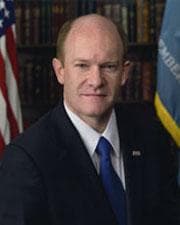
- Christopher Coons
- Cosponsors
- - 3 - 4
- Introduced
- On Calendar
What this bill would do
This bill, known as the DISRUPT Act, requires the executive branch to create a whole-of-government strategy to disrupt the growing cooperation among the People's Republic of China, the Russian Federation, the Islamic Republic of Iran, and the Democratic People's Republic of Korea. It mandates the establishment of specific task forces within various federal agencies to monitor and evaluate the risks posed by these adversaries. The legislation directs the Director of National Intelligence to report on the nature and trajectory of this cooperation. Additionally, the Secretary of State and Secretary of Defense must outline a strategic approach to disrupt and constrain these growing partnerships. The ultimate goal is to bolster deterrence and prepare the United States for potential simultaneous challenges in multiple theaters.
Yes· 3 of 6
Does this strengthen ties with allied countries?+7
The bill emphasizes strengthening ties and collaborative efforts with international partners and allies.
Does this better protect the country from computer attacks?+5
The bill addresses coordination on cyber operations by adversary nations.
Does this send more money or help to other countries?+5
The bill calls for more effective use of Foreign Military Financing to support allies.
The opposite
No question was scored the opposite.
Who it would affect, and how
Potential Positive Impacts for People
-
Bolstering International Deterrence: The bill aims to bolster deterrence across priority theaters including the Indo-Pacific, Europe, and the Middle East to prepare for potential conflicts (Section 3, paragraph 3).
-
Supporting Frontline Partners: The strategy includes increasing munitions stockpiles specifically to support critical frontline partners such as Israel, Taiwan, and Ukraine (Section 4, paragraph c, subparagraph D, clause i).
-
Strengthening Allied Defense Production: The plan facilitates collaborative efforts with allies for the co-production, co-maintenance, and co-sustainment of critical munitions and platforms (Section 4, paragraph c, subparagraph D, clause ii).
-
Protecting Technological Edges: By disrupting the sharing of critical military technologies among adversaries, the bill seeks to prevent the erosion of the technological edge of the United States Armed Forces (Section 2, paragraph 8, subparagraph B).
Potential Negative Impacts for People
-
Increased Risk of Simultaneous Conflicts: The bill acknowledges that the increasing alignment of these adversaries increases the chance that a conflict with one could draw in another, potentially forcing the United States to contend with simultaneous threats in one or more theaters (Section 2, paragraph 8, subparagraph E).
-
Economic and Sanction Risks: The cooperation among these adversaries is noted as a threat to the effectiveness of United States economic tools, as they work to evade sanctions and establish alternative payment systems that do not require the use of the United States dollar (Section 2, paragraph 8, subparagraph D).
Groups and Interests Ranking
Every group the model scored this bill for, from -10 to +10. Hover a score for the reason it gave.
- National Security And Foreign Policy
- Improves International Alliances+7Improves Cybersecurity Defense+5Improves Diplomatic Engagement+5Increases Foreign Aid+5
- Governance And Ideology
- Increases Federal Power+5Improves Government Transparency+3
- 6/18/2025
- Committee on Foreign Relations. Reported by Senator Risch with an amendment in the nature of a substitute. Without written report.
- Placed on Senate Legislative Calendar under General Orders. Calendar No. 99.
- 6/17/2025
- 3 Cosponsors added.
- 6/9/2025
- 3 Cosponsors added.
- 6/5/2025
- Committee on Foreign Relations. Ordered to be reported with an amendment in the nature of a substitute favorably.
- 5/22/2025
- Read twice and referred to the Committee on Foreign Relations.
- 1 Cosponsor added.
- Introduced in Senate
One bill Congress.gov lists as related to this one — companions in the other chamber, earlier versions, and bills this one absorbed or was folded into.
 Michael Bennet
Democrat · Colorado
 John Cornyn
Republican · Texas
 Amy Klobuchar
Democrat · Minnesota
 Markwayne Mullin
Republican · Oklahoma
 David McCormick
Republican · Pennsylvania
 Dan Sullivan
Republican · Alaska
 Elissa Slotkin
Democrat · Michigan