Bill · H.Con.Res. 45· House(119-HCONRES-45)
Recognizing the need to improve physical access to many federally funded facilities for all people of the United States, particularly people with disabilities.
- Introduced
- 7/23/2025
- Last activity
- 7/23/2025 — Referred to the Committee on Education and Workforce, and in addition to the Committees on the Judiciary, Transportation and Infrastructure, Energy and Commerce, and Oversight and Government Reform, for a period to be subsequently determined by the Speaker, in each case for consideration of such provisions as fall within the jurisdiction of the committee concerned.
- Sponsored by
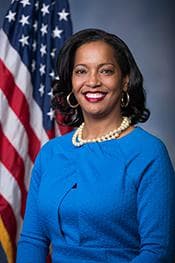
- Jahana Hayes
- Cosponsors
- - 16 - 0
- Introduced
- In Committee
A concurrent resolution is how the House and the Senate settle something they do together, such as a budget plan or a joint session. It is adopted once both chambers agree to it, and that puts it into effect; it is not a law, so it does not go to the President.
What this bill would do
This concurrent resolution recognizes the need to improve physical access to federally funded facilities for all people, specifically those with disabilities. It highlights that many Americans face daily barriers to access despite the existence of the Americans with Disabilities Act and the Architectural Barriers Act. The resolution points to advancements in technology and the increasing number of people living with disabilities due to aging and medical advancements. It also notes that the Department of Transportation has adopted new accessibility guidelines for pedestrian facilities. Ultimately, the House of Representatives resolves to recognize these daily barriers and reaffirm support for existing accessibility laws. Finally, Congress pledges to use universal and inclusive design as a guiding principle for future infrastructure projects.
Yes· 3 of 7
Would people with disabilities be better off under this?+8
The resolution explicitly pledges to make universal and inclusive design a guiding principle for all future infrastructure projects to remove daily barriers.
Does this expand the rights of people with disabilities?+7
The resolution reaffirms support for the Americans with Disabilities Act and pledges to use universal design to remove physical barriers to federally funded facilities.
Would veterans be better off under this, taking everything together?+5
The resolution highlights that many veterans have service-connected disabilities and emphasizes the need for improved physical access.
The opposite
No question was scored the opposite.
Who it would affect, and how
Potential Positive Impacts for People
-
Improved Equality and Access: The resolution aims to ensure all people, regardless of physical ability, have equal opportunity to access federally funded amenities (Preamble).
-
Enhanced Pedestrian Safety and Convenience: By addressing the Board's guidelines, the resolution supports better access to sidewalks, streets, crosswalks, and curb ramps to provide the same degree of safety and convenience afforded to the general public (P�reamble).
-
Commitment to Future Infrastructure: Congress pledges to make universal and inclusive design a guiding principle for all future infrastructure bills and projects to help remove barriers (Resolution Section 3).
-
Support for Vulnerable Groups: The text notes the importance of accessibility for veterans with service-connected disabilities, the aging population, and people of color who have high disability rates (Preamble).
Potential Negative Impacts for People
- No negative impacts or burdens are explicitly stated in the provided text.
Groups and Interests Ranking
Every group the model scored this bill for, from -10 to +10. Hover a score for the reason it gave.
- Demographic And Interest Groups
- Good For People With Disabilities+8Good For Veterans+5Good For Seniors+4Good For African Americans+3
- Social Issues And Justice
- Improves Disability Rights+7Improves Racial Equity+3
- Environment Energy And Infrastructure
- Improves Public Transit+5
- 8/26/2025
- 1 Cosponsor added.
- 7/25/2025
- 1 Cosponsor added.
- 7/23/2025
- Submitted in House
- Referred to the Committee on Education and Workforce, and in addition to the Committees on the Judiciary, Transportation and Infrastructure, Energy and Commerce, and Oversight and Government Reform, for a period to be subsequently determined by the Speaker, in each case for consideration of such provisions as fall within the jurisdiction of the committee concerned.
- 14 Cosponsors added.
2 bills Congress.gov lists as related to this one — companions in the other chamber, earlier versions, and bills this one absorbed or was folded into.
- 119-HCONRES-112: Recognizing the need to improve physical access to many federally funded facilities for all persons of the United States, particularly persons with disabilities.
- 119-SCONRES-19: A concurrent resolution recognizing the need to improve physical access to many federally funded facilities for all people of the United States, particularly people with disabilities.
 Steve Cohen
Democrat · Tennessee
 Donald Davis
Democrat · North Carolina
 Debbie Dingell
Democrat · Michigan
 Dwight Evans
Democrat · Pennsylvania
 Pablo Hernández
Democrat · Puerto Rico
 Kevin Mullin
Democrat · California
 Eleanor Norton
Democrat · District of Columbia
 Brad Sherman
Democrat · California
 Janice Schakowsky
Democrat · Illinois
 Eric Swalwell
Democrat · California
 Darren Soto
Democrat · Florida
 Dina Titus
Democrat · Nevada
 Paul Tonko
Democrat · New York
 Rashida Tlaib
Democrat · Michigan
 Jill Tokuda
Democrat · Hawaii
 Bonnie Watson Coleman
Democrat · New Jersey