Bill · S.Res. 75· Senate(119-SRES-75)
A resolution expressing the sense of the Senate that member countries of NATO must commit at least 2 percent of their national gross domestic product to national defense spending to hold leadership or benefit at the expense of those countries who meet their obligations.
- Introduced
- 2/12/2025
- Last activity
- 2/12/2025 — Referred to the Committee on Foreign Relations. (text: CR S931)
- Sponsored by
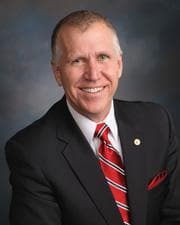
- Thomas Tillis
- Cosponsors
- - 9 - 0
- Introduced
- In Committee
A Senate resolution is the Senate speaking for itself: stating a position, honouring someone, or setting its own rules. Adopting it is the whole process. Once the Senate agrees to it, it is officially the Senate's word; it is not a law, so the House and the President have no part in it.
What this bill would do
This resolution expresses the sense of the Senate regarding NATO member country obligations. It calls for member countries to commit at least 2 percent of their national gross domestic product to national defense spending. The resolution suggests that countries failing to meet this requirement should not hold certain leadership positions within NATO. It also targets leadership roles such as the Secretary General and various high-level military positions. Furthermore, it proposes that countries not meeting the spending threshold should be barred from hosting significant NATO meetings or summits. This is intended to ensure that those who meet their obligations are not disadvantaged.
Yes
Does this strengthen ties with allied countries?+3
The resolution seeks to strengthen NATO by ensuring all members meet financial obligations for mutual defense.
Does this increase the pay, pensions or support veterans receive?+2
The bill aims to increase military readiness through higher defense spending commitments.
Would veterans be better off under this, taking everything together?+2
Increased defense spending could support better military readiness and structure.
The opposite
No question was scored the opposite.
Who it would affect, and how
Potential Positive Impacts for People
-
Ensuring Military Readiness: The text notes that the 2 percent commitment is intended to help ensure the continued military readiness of NATO.
-
Protecting those meeting obligations: The resolution states that these measures are meant to ensure that those who meet their obligations do not suffer at the expense of those who do not.
Potential Negative Impacts for People
-
Restrictions on Leadership Roles: Under section (1), citizens of member countries that do not meet the 2 percent GDP spending requirement could be barred from holding leadership positions such as the Secretary General, Deputy Secretary General, Assistant Secretaries General, NATO Spokesperson, or uniformed military leadership at the 2-star level or above.
-
Loss of Economic and Recognition Opportunities: Under section (2), member countries that fail to meet the 2 percent commitment would not be allowed to host significant formal or informal meetings, conferences, or summits at the ministerial level or above. This includes the NATO Summit, meetings of NATO Ministers of Foreign Affairs, NATO Parliamentary Assembly sessions, or the NATO Youth Summit, which are noted as events that provide substantial economic benefit and international recognition.
Groups and Interests Ranking
Every group the model scored this bill for, from -10 to +10. Hover a score for the reason it gave.
- National Security And Foreign Policy
- Improves International Alliances+3Improves Veterans Benefits+2
- Demographic And Interest Groups
- Good For Veterans+2
- 7/17/2025
- 2 Cosponsors added.
- 2/19/2025
- 1 Cosponsor added.
- 2/12/2025
- Referred to the Committee on Foreign Relations. (text: CR S931)
- 6 Cosponsors added.
- Introduced in Senate
 John Boozman
Republican · Arkansas
 Shelley Capito
Republican · West Virginia
 John Cornyn
Republican · Texas
 Steve Daines
Republican · Montana
 Lindsey Graham
Republican · South Carolina
 James Justice
Republican · West Virginia
 Mike Lee
Republican · Utah
 David McCormick
Republican · Pennsylvania
 Tim Sheehy
Republican · Montana