 Bill · S. 1345· Senate(119-S-1345)
America's First Fuels Act
- Introduced
- 4/8/2025
- Last activity
- 4/8/2025 — Read twice and referred to the Committee on Finance.
- Sponsored by
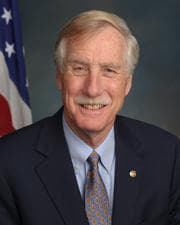
- Angus King
- Cosponsors
- - 0 - 2
- Introduced
- In Committee
What this bill would do
The America's First Fuels Act aims to amend the Internal Revenue Code of 1986 regarding biomass energy. It seeks to increase the limitations on credits for biomass stoves and boilers under the energy efficient home improvement credit. Additionally, the bill introduces a new investment tax credit specifically for open-loop biomass heating property. This new credit is set at 30 percent of the basis of the property placed in service. These changes are intended to apply to property placed in service after December 31, 2025.
Yes· 3 of 6
Does this put more money into wind, solar and other renewable power?+6
The bill introduces new tax credits specifically for open-loop biomass heating property.
Would middle-income households be better off under this?+5
The increased energy efficiency tax credits provide direct financial relief to middle-class homeowners.
Does this cut taxes for middle-income families?+5
The bill increases tax credits for home heating equipment like biomass stoves and boilers, which benefits middle-class homeowners.
The opposite
No question was scored the opposite.
Who it would affect, and how
Potential Positive Impacts for People
-
Increased tax credits for home heating: Under Section 2, the bill increases the aggregate limits for property related to biomass stoves and boilers. This provides higher credit amounts for property described in subsection (d)(2)(A) up to $2,000 and subsection (d)(2)(B) up to $10,000 (Section 2(a)).
-
New investment tax credit for biomass heating: Section 3 introduces an "open-loop biomass heating property credit." This allows for a credit of 30 percent of the basis of the property placed in service (Section 3(a)). This can be used for space heating, air conditioning, domestic hot water, or industrial process heat (Section 3(b)(1)(A)).
Potential Negative Impacts for People
- Strict requirements for boilers and furnaces: For certain equipment to qualify for the new credit, the bill mandates specific efficiency and installation standards. This includes a requirement for thermal output efficiencies of at least 75 percent, indoor installation, a scale smaller than 50 MMBtu, and the use of an electrostatic precipitator or similar emissions control technology (Section 3(b)(2)).
Groups and Interests Ranking
Every group the model scored this bill for, from -10 to +10. Hover a score for the reason it gave.
- Environment Energy And Infrastructure
- Increases Renewable Energy Investment+6Improves Environmental Protections+3Reduces Carbon Emissions+3
- Demographic And Interest Groups
- Good For Middle Class Households+5Good For Rural Residents+3
- Economy And Finance
- Reduces Middle Class Taxes+5
- 5/5/2025
- 1 Cosponsor added.
- 4/9/2025
- 1 Cosponsor added.
- 4/8/2025
- Read twice and referred to the Committee on Finance.
- 2 Cosponsors added.
- Introduced in Senate
 Susan Collins
Republican · Maine
 Maggie Hassan
Democrat · New Hampshire
 Lisa Murkowski
Republican · Alaska
 Jeanne Shaheen
Democrat · New Hampshire