Bill · S. 4392· Senate(119-S-4392)
Energy Security Pacts Act
- Introduced
- 4/27/2026
- Last activity
- 7/27/2026 — Placed on Senate Legislative Calendar under General Orders. Calendar No. 508.
- Sponsored by
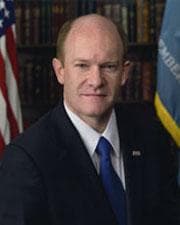
- Christopher Coons
- Cosponsors
- - 1 - 2
- Introduced
- On Calendar
What this bill would do
This bill establishes "Energy Security Pacts" to strengthen the energy and economic security of the United States and its partner countries. These multiyear agreements focus on diversifying critical mineral and energy supply chains to counter economic coercion. The Secretary of State is authorized to lead these efforts through a newly created Office of Energy Security Pacts. An Energy Security Pacts Council will be established to coordinate activities across various federal agencies. The program aims to increase reliable access to energy while stimulating economic growth in partner nations.
Yes· 3 of 9
Does this send more money or help to other countries?+6
The bill establishes a mechanism for increased foreign assistance through energy security pacts.
Does this strengthen ties with allied countries?+5
The bill promotes through pacts closer economic and energy ties with partner countries.
Is this likely to grow the economy?+5
The pacts are designed to stimulate economic growth in both the United States and partner countries.
The opposite
Does this better protect air, water and wildlife?-2
While it prohibits projects causing significant hazards, the focus is on resource extraction which often impacts environments.
Who it would affect, and how
Potential Positive Impacts for People
-
Increased Economic Growth and Stability: The pacts aim to stimulate economic growth and enhance economic security for both the United States and partner countries (Section 3(a), Section 5(a)).
-
Enhanced Energy Access: The goal of these agreements is to increase reliable access to energy or electricity, which can include production needed for critical minerals (Section 5(a)).
-
Supply Chain Diversification: The bill works to diversify critical mineral and energy supply chains, which helps counter economic coercion (Section 3(a)).
-
Support for Private Investment: By improving infrastructure and economic conditions, the pacts aim to enable follow-on private sector investment (Section 5(a)).
-
Tax Relief for Assistance: Each pact includes a provision stating that United States assistance is exempt from taxation by the government of the partner country (Section 5(d)(2)).
Potential Negative Impacts for People
-
Risk of Job Loss or Production Displacement: The bill includes a provision that assistance may not be provided for projects likely to cause a substantial loss of United States jobs or a substantial displacement of United States production (Section 3(d)(2)).
-
Environmental, Health, or Safety Risks: Assistance is prohibited for any project that is likely to cause a significant environmental, health, or safety hazard (Section 3(d)(3)).
-
Prohibition on Military Aid: The bill explicitly states that assistance under this section may not include military assistance or military training for a country (Section 3(d)(1)).
Groups and Interests Ranking
Every group the model scored this bill for, from -10 to +10. Hover a score for the reason it gave.
- National Security And Foreign Policy
- Increases Foreign Aid+6Improves International Alliances+5Improves Diplomatic Engagement+4Improves International Trade+4
- Economy And Finance
- Improves Economic Growth+5Increases Job Creation+3
- Governance And Ideology
- Increases Federal Power+3Improves Government Transparency+2
- Demographic And Interest Groups
- Good For Business Owners+4
- Environment Energy And Infrastructure
- Improves Environmental Protections-2
- 7/27/2026
- Committee on Foreign Relations. Reported by Senator Risch with an amendment in the nature of a substitute. Without written report.
- Placed on Senate Legislative Calendar under General Orders. Calendar No. 508.
- 6/17/2026
- Committee on Foreign Relations. Ordered to be reported with an amendment in the nature of a substitute favorably.
- 5/14/2026
- 2 Cosponsors added.
- 4/27/2026
- Read twice and referred to the Committee on Foreign Relations.
- 1 Cosponsor added.
- Introduced in Senate
 John Curtis
Republican · Utah
 John Hickenlooper
Democrat · Colorado
 Pete Ricketts
Republican · Nebraska