Bill · S. 1589· Senate(119-S-1589)
Immigration Parole Reform Act of 2025
- Introduced
- 5/5/2025
- Last activity
- 5/5/2025 — Read twice and referred to the Committee on the Judiciary.
- Sponsored by
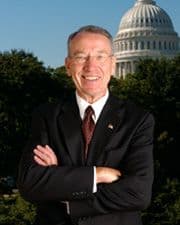
- Chuck Grassley
- Cosponsors
- - 12 - 0
- Introduced
- In Committee
What this bill would do
The Immigration Parole Reform Act of 2025 aims to amend the Immigration and Nationality Act to reform how immigration parole is handled. It restricts the Secretary of Homeland Security's discretion by narrowing the specific reasons an alien can be paroled into the United States. The bill defines specific categories for humanitarian reasons and significant public benefits, such as medical emergencies or assisting in law enforcement. It also provides specific parole criteria for spouses or children of active-duty military members and certain Cuban nationals. Additionally, the Act introduces new rules regarding the duration of parole and employment authorization.
Yes
Does this make what the government does easier for the public to see?+5
The bill requires the Secretary of Homeland Security to submit annual reports on parole data to Congress and the public.
Does this make health care easier to get in general?+5
The bill allows for parole for urgent humanitarian reasons including life-threatening medical emergencies.
Does this increase the pay, pensions or support veterans receive?+5
The bill provides specific parole criteria for spouses or children of active-duty military members.
The opposite· 3 of 4
Would immigrants be better off under this?-4
The bill limits parole duration, restricts employment, and creates stricter eligibility for adjusting status.
Does this make it easier for immigrants already here to become citizens?-3
The bill restricts eligibility for adjustment of status for many paroled individuals.
Would households on low incomes be better off under this?-2
The bill restricts employment opportunities for most paroled individuals, which may impact their ability to support themselves.
Who it would affect, and how
Potential Positive Impacts for People
-
Military Families: The Secretary may grant parole to the spouse or child of a member of the Armed Forces serving on active duty who is the beneficiary of an approved petition and is not otherwise inadmissible (Section 2, Subparagraph B).
-
Cuban Nationals: Certain Cuban nationals living in Cuba who meet specific eligibility requirements and are beneficiaries of an approved petition may be granted parole (Section s, Subparagraph C).
-
Medical and Family Emergencies: Individuals may be granted parole for urgent humanitarian reasons, such as a life-threatening medical emergency, the need to donate organs, or witnessing the imminent death or funeral of a close family member (Section 2, Subparagraph D).
-
Law Enforcement Assistance: An alien may be paroled if their presence provides a significant public benefit by assisting the United States Government in a law enforcement matter (Section 2, Subparagraph E).
-
Legal Status Adjustments: Aliens who are lawful applicants for adjustment of status under section 245 can request extensions of parole in 1-year increments while their application is pending (Section 2, Subparagraph J).
Potential Negative Impacts for People
-
Employment Restrictions: Generally, an alien granted parole is not allowed to accept employment, which could create a financial burden (Section 2, Subparagraph H).
-
Limited Parole Duration: Parole is restricted to a shorter period, either the time needed to complete the activity for which it was granted or one year, which may limit a person's time in the country (Section 2, Subparagraph J).
-
Strict Eligibility for Status Adjustment: An alien granted parole is not eligible to adjust their status to lawful permanent residence if the immigration status they held at the time of departure did not allow for such an adjustment (Section 2, Subparagraph I).
-
Requirement to Return: Once the purpose of the parole has been served, the alien is required to immediately return or be returned to the custody from which they were paroled (Section 2, Subparagraph A).
Groups and Interests Ranking
Every group the model scored this bill for, from -10 to +10. Hover a score for the reason it gave.
- Demographic And Interest Groups
- Good For Immigrants-4Good For Hispanic Americans-2Good For Low Income Households-2
- Governance And Ideology
- Improves Government Transparency+5
- Healthcare
- Improves Healthcare Access+5
- National Security And Foreign Policy
- Improves Veterans Benefits+5
- Social Issues And Justice
- Improves Pathway To Citizenship-3
- 7/31/2025
- 1 Cosponsor added.
- 5/5/2025
- Read twice and referred to the Committee on the Judiciary.
- 11 Cosponsors added.
- Introduced in Senate
2 bills Congress.gov lists as related to this one — companions in the other chamber, earlier versions, and bills this one absorbed or was folded into.
 Ted Budd
Republican · North Carolina
 Katie Britt
Republican · Alabama
 Bill Cassidy
Republican · Louisiana
 Tom Cotton
Republican · Arkansas
 Joni Ernst
Republican · Iowa
 Cindy Hyde-Smith
Republican · Mississippi
 Josh Hawley
Republican · Missouri
 James Lankford
Republican · Oklahoma
 Mike Lee
Republican · Utah
 Bernie Moreno
Republican · Ohio
 Tim Sheehy
Republican · Montana
 Tommy Tuberville
Republican · Alabama