Bill · H.Res. 756· House(119-HRES-756)
Supporting the designation of September 2025 as "National Voting Rights Month".
- Introduced
- 9/19/2025
- Last activity
- 9/19/2025 — Referred to the Committee on the Judiciary, and in addition to the Committees on House Administration, Science, Space, and Technology, Oversight and Government Reform, Financial Services, Ways and Means, Natural Resources, and Homeland Security, for a period to be subsequently determined by the Speaker, in each case for consideration of such provisions as fall within the jurisdiction of the committee concerned.
- Sponsored by
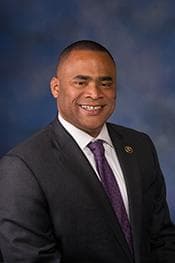
- Marc Veasey
- Cosponsors
- - 22 - 0
- Introduced
- In Committee
A House resolution is the House speaking for itself: stating a position, honouring someone, or setting its own rules. Adopting it is the whole process. Once the House agrees to it, it is officially the House's word; it is not a law, so the Senate and the President have no part in it.
What this bill would do
H. Res. 756 is a resolution to support the designation of September 2025 as "National Voting Rights Month." The resolution encourages the protection of the fundamental right to vote and expresses support for passing the Freedom to Vote Act and the Democracy Restoration Act of 2023. It also recommends that schools and universities teach students about voting and the history of voter suppression. Additionally, it invites Congress to fund public service announcements to inform citizens about election dates and registration deadlines.
Yes· 3 of 23
Does this protect the right to vote?+10
The primary purpose of the bill is to support the designation of National Voting Rights Month and promote voting access.
Does this make casting a ballot easier in practice?+10
The bill explicitly encourages legislation to expand voter registration and voting access.
Would Black Americans be better off under this?+9
Specifically highlights the historical and current voter suppression targeting Black Americans.
The opposite
Does this leave more decisions to the states?-3
The bill advocates for federal oversight to counteract state-level voting restrictions.
Who it would affect, and how
Potential Positive Impacts for People
-
Increased Voter Awareness: By designating a "National Voting Rights Month" and funding public service announcements, the resolution aims to remind people when elections are held and share registration deadlines. (Resolved section 1 and 6)
-
Educational Opportunities: The recommendation for public schools and universities to develop curricula on how to register and the importance of voting could better inform students on exercising their rights. (Resolved section 4)
-
Expanded Voting Access: The expression of support for the Freedom to Vote Act seeks to set national standards to expand voter registration and voting access. (Resolved section 3A)
-
Restoration of Rights: The support for the Democracy Restoration Act of 2023 focuses on restoring Federal voting rights to citizens after they are released from imprisonment. (Resolved section 3B)
Potential Negative Impacts for People
- There are no negative consequences or burdens for individuals explicitly listed within the text of this resolution.
Groups and Interests Ranking
Every group the model scored this bill for, from -10 to +10. Hover a score for the reason it gave.
- Demographic And Interest Groups
- Good For African Americans+9Good For Asian Americans+8Good For Hispanic Americans+8Good For Native Americans+8Good For Students+7Good For Low Income Households+6Good For People With Disabilities+6Good For Young Adults+6Good For Men+5Good For Middle Aged+5Good For Middle Class Households+5Good For Retirees+5Good For Rural Residents+5Good For Seniors+5Good For Urban Residents+5Good For Women+5Good For White Americans+4
- Social Issues And Justice
- Improves Voting Access+10Improves Voting Rights+10Improves Racial Equity+7Improves Disability Rights+3
- Governance And Ideology
- Improves Electoral Process+8Increases Federal Power+3Increase States Rights-3
- 9/19/2025
- Submitted in House
- Referred to the Committee on the Judiciary, and in addition to the Committees on House Administration, Science, Space, and Technology, Oversight and Government Reform, Financial Services, Ways and Means, Natural Resources, and Homeland Security, for a period to be subsequently determined by the Speaker, in each case for consideration of such provisions as fall within the jurisdiction of the committee concerned.
- 22 Cosponsors added.
 Yassamin Ansari
Democrat · Arizona
 Nanette Barragán
Democrat · California
 Emanuel Cleaver
Democrat · Missouri
 Troy Carter
Democrat · Louisiana
 Jasmine Crockett
Democrat · Texas
 Christopher Deluzio
Democrat · Pennsylvania
 Sharice Davids
Democrat · Kansas
 Cleo Fields
Democrat · Louisiana
 Al Green
Democrat · Texas
 Henry Johnson
Democrat · Georgia
 Julie Johnson
Democrat · Texas
 Sydney Kamlager-Dove
Democrat · California
 Betty McCollum
Democrat · Minnesota
 Grace Meng
Democrat · New York
 Kevin Mullin
Democrat · California
 Jennifer McClellan
Democrat · Virginia
 Johnny Olszewski
Democrat · Maryland
 Stacey Plaskett
Democrat · Virgin Islands
 Robert Scott
Democrat · Virginia
 Terri Sewell
Democrat · Alabama
 Nikema Williams
Democrat · Georgia
 Bonnie Watson Coleman
Democrat · New Jersey